Story Two: The Night-Shift Neighbour
I noticed the silence immediately.
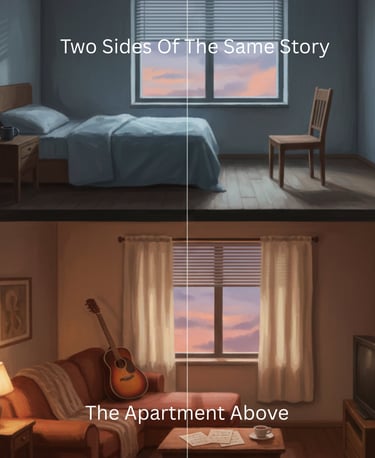
Not because I was waiting for it — at least, not consciously — but because my body had learned the shape of her nights. The low hum of the building, the distant traffic, and somewhere beneath my feet, the careful sound of a guitar trying not to be too much.
When it wasn’t there, something felt wrong.
I work nights at the hospital. Twelve-hour shifts that leave your bones tired and your mind oddly alert, like you’ve been trained to stay open even when the world is closed. Sleep comes in fragments. You learn to listen without reacting, to notice without intruding.
That’s how I heard her the first time.
It was close to midnight, and I was lying on the couch with my boots still on, staring at the ceiling while my brain tried to wind down. The sound floated up through the floor — tentative, almost apologetic.
Not loud. Not careless.
Just… present.
I remember thinking, Someone is being brave very quietly.
The song stopped before it really began.
I waited, holding my breath like the sound might come back if I didn’t disturb it.
It didn’t.
The next morning, I wrote the note.
I chose my words carefully. I always do. The job trains you that way — tone matters, even when content is neutral.
The walls are thin. No worries, just a heads-up.
I signed it Upstairs, because names create weight, and I didn’t want to scare her off.
Her reply came later that day. Apologetic. Polite. Promising restraint.
I should have been relieved.
Instead, I felt a small, unexpected loss.
The music all but disappeared after that. When it did appear, it was during the hours people assume are safe — late morning, early afternoon.
Unfortunately, those are my hours.
I sleep lightly. Always have. Even more so after nights where I’ve held people’s hands while machines beeped in careful rhythms. Sound travels into me whether I invite it or not.
Her guitar filtered into my sleep like something half-remembered. Fragments of melody. Notes that felt like questions left unanswered.
I started setting my alarm earlier.
Not because I needed to wake up — but because I didn’t want to miss the end.
When she left the note about pacing, I smiled. I could picture it: restless energy, thoughts too loud to settle.
Pacing is fine. I work nights — I’m usually awake anyway.
That was true.
What I didn’t say was that I was awake for her now.
After that, the music returned — cautious, but intentional. Still soft, still restrained, but no longer hiding.
I listened intentionally.
I planned my sleep around it. Took shorter naps. Let myself run a little tired, because there was something grounding about knowing that while I held my life together in other people’s emergencies, someone below me was turning their feelings into sound.
I didn’t hear a nuisance.
I heard care.
When I wrote that the song sounded unfinished, I was telling the truth. It felt like it had stopped because it was afraid of being seen.
Her reply came quickly.
It was unfinished. I get nervous halfway through.
That line stayed with me longer than it should have.
People don’t usually admit that kind of vulnerability to strangers. Not without cushioning it.
I answered honestly.
It didn’t sound nervous.
From then on, the music changed.
Not in volume — in trust.
She played like she knew someone was listening. Not an audience. A person.
She left a note one night that made my chest tighten.
That one was about feeling like a burden.
I stood in my kitchen for a long time after reading it, the note trembling slightly between my fingers.
I chose my response with care.
I don’t hear a burden. I hear someone trying.
I hoped she understood what I meant.
That trying mattered.
That sound was allowed.
That she didn’t need to justify her existence.
After that, she played later.
Not louder.
Just later.
Like she’d realised I would be there.
And then — nothing.
The first night, I assumed she was tired.
The second, busy.
The third, I knew something was wrong.
Silence has texture when you’re used to sound. It presses instead of settling. The building felt hollow without her music threading through it.
I waited another night.
Then I wrote a note.
No reply.
That’s when I realised the silence wasn’t rest.
It was withdrawal.
I stood at the top of the stairs longer than I meant to, staring at her door like it might tell me what I needed to know. I told myself not to interfere. That people are allowed to go quiet.
But people who think they’re burdens go quiet to protect others.
And I couldn’t let her believe that.
So I knocked.
Not hard. Not urgent.
Just enough to be heard.
I heard movement immediately — a sharp intake of breath, then footsteps approaching the door like she wasn’t sure she was allowed to open it.
When she did, she looked surprised.
Tired. Guarded. Real.
For a moment, we just stared at each other — two people who knew each other through paper and sound and absence, suddenly compressed into a doorway.
“Hi,” she said.
“Hi,” I replied.
“I hope this is okay,” I said, because consent matters even in small things. “You haven’t been playing. I just wanted to check that you were alright.”
Her shoulders dropped, just a little.
“I’m okay,” she said. “Just… quiet.”
“That’s allowed,” I told her. And meant it.
She hesitated, then said, “I didn’t know if the music was… too much.”
The answer came easily.
“It wasn’t,” I said. Then softened it, because she needed softness. “It isn’t.”
Something shifted in her expression — surprise, then something like relief.
We stood there, the history between us suddenly obvious.
“You can play anytime,” I added.
The words felt important. Like permission, but also like truth.
Her eyes flicked away, then back. “I didn’t realise anyone was really listening.”
“I was,” I said.
I didn’t add on purpose. I didn’t need to.
She nodded slowly, absorbing that.
When I turned to leave, she spoke again.
“I might finish it,” she said. “The song.”
I smiled. “I’d like to hear it.”
That was enough.
I didn’t ask for her name that night. I didn’t ask for anything she wasn’t ready to give. Some connections need time to adjust to daylight.
The next afternoon, I woke to music.
Not tentative this time.
Certain.
I lay there, eyes closed, listening as the song unfolded fully — the hesitations resolved, the melody choosing itself.
I didn’t need to knock again.
She knew I was there.
And for the first time since I’d moved into that building, the space above and below my life felt connected — not by walls or floors, but by choice.
If you’d like the complete pair as a polished keepsake:
👉 Collector Edition on Etsy (both stories + bonus epilogue).
Contact
Questions or thoughts? Reach out anytime.
© 2025. All rights reserved.