The Bookshop Rival
Story Two: June’s POV
The week my aunt died, I stopped answering my phone.
Not because I didn’t care. Because I cared too much, and every call felt like another hand reaching in to rearrange the grief before I’d even learned its shape.
Aunt May had been the kind of woman who collected things the way other people collected friends. Teacups with chipped rims, postcards from towns she’d never visited, first editions she’d found under tables at estate sales. She collected stories too, not just in books but in people.
When she left me her shop, it felt like she’d handed me something alive.
Juniper & Co. sat on the main street like it had always belonged there, but it hadn’t. The space had been a florist, then a café with too many mismatched chairs and not enough customers. I’d turned it into a bookshop because I couldn’t think of anything else that would hold me together.
I’d had a corporate job before this. Clean lines, predictable outcomes, a salary that came with health insurance and a polite kind of emptiness.
Then May got sick, and I watched how people came into her hospital room carrying flowers and casseroles and silence. I watched how she kept asking for books like the right story might make her body behave.
One afternoon, she’d taken my hand, eyes bright with stubbornness, and said, “If I leave you anything, it’ll be something that keeps you honest.”
The shop did that.
It exposed me.
It demanded I be present.
It also made me visible in a way I wasn’t sure I wanted.
Especially to her.
Across the street, Ruth’s Book Nook had been there forever. It was older than most of the businesses around it, the kind of place that smelled like paper and lemon polish and the slow patience of someone who didn’t believe in rushing.
When I first opened my doors, I felt her watching me.
Not constantly. Not dramatically. Just… often enough that I noticed.
She worked behind the counter like she’d been built into it. Calm, efficient, always a little guarded. She had a face that could have been warm if she let it, but most of the time she wore her expression like a closed book.
Ruth herself had been friendly, in the way older women can be when they’ve already decided you’re harmless. She’d come over once, stood in my shop doorway and looked around like she was inspecting a new neighbour’s fence.
“Wide windows,” she’d said finally, as if diagnosing something.
“People like to see in,” I’d replied, trying not to sound defensive.
Ruth had sniffed. “Books don’t need to be displayed like shoes.”
“I’m not selling shoes.”
“No,” she’d said, eyeing my face-out display. “You’re selling attention.”
Then she’d left.
And for a while, that was that.
But the younger woman, the one who worked in Ruth’s shop, was different. She didn’t come over. She didn’t introduce herself. She didn’t smile unless she had to.
She just watched.
And because I was newly running a business on a street with limited foot traffic, I watched back.
Not to outlast her.
To understand.
It’s strange, the stories you make up when you don’t have information. How quickly your brain fills gaps with worst-case versions, especially when you’re tired and grieving and trying to prove you belong somewhere you still feel like an imposter.
I told myself she hated me.
I told myself she thought I was a gimmick.
I told myself she hoped I’d fail so the street would go back to normal.
Sometimes, when I was rearranging displays, I’d catch her looking through the window from across the road. If our eyes met, she always looked away, as if she’d been caught doing something she didn’t want to admit.
I pretended not to notice.
I knew what it felt like to be seen when you weren’t ready.
When Ruth died, the street changed.
The first day after the funeral, I noticed her shop’s lights were on, but the movement inside was different. The air felt heavier, even from across the road. Customers came in slowly, carrying sympathy like it was a physical object.
I watched her behind the counter, her shoulders held too rigidly, like if she softened she’d come apart.
I should have gone over.
I didn’t.
Not because I didn’t care. Because I didn’t know if I had the right. Grief has invisible fences around it. You don’t climb them without invitation.
A week later, I overheard someone in my shop say, “I thought Ruth’s place closed. I go here now.”
I turned sharply before I could stop myself.
The woman laughed lightly, as if it was nothing.
It wasn’t nothing.
I felt sick, immediately, like I’d stolen something without meaning to. Like my success had teeth.
Across the street, the younger woman stayed open later that evening. I saw her lights on after mine were off, her silhouette moving among the shelves.
I wondered what it was like in there without Ruth.
I wondered if she was alone.
It took me far too long to admit that my curiosity had become something else entirely.
Not attraction, I told myself.
Not yet.
Just awareness.
The rain started midweek, soft at first, then relentless. It was the kind of weather that made the world narrow, pushing everyone inward.
Business slowed. People didn’t linger. They darted in, bought something quickly, and left with their shoulders hunched.
On the fourth day, I was wiping water off the inside of my windows when I saw her rush out of Ruth’s shop carrying a cardboard box. She moved fast, jaw clenched, hair slightly frizzed from humidity.
Then another box.
Then a bucket.
Something flashed across the street, sharp and wrong.
Panic.
I didn’t think.
I grabbed my coat and crossed through the rain, shoes splashing in puddles that had formed too quickly. When I reached her shop, the bell chimed as I stepped inside, and I stopped dead.
The floor glistened.
Buckets scattered.
Books stacked on chairs, on the counter, on anything raised above the creeping water that had begun to own the back corner.
Her face was flushed with effort, eyes bright in a way that looked like she was holding herself together by sheer force.
“Oh,” I said, because it was the only word that arrived fast enough. “That’s… bad.”
Her head snapped up. “I’ve got it handled.”
She did not.
I swallowed down the instinct to soften it. Sometimes softness sounds like pity. And she didn’t need pity. She needed help.
I took a step inside anyway, eyes scanning. “You don’t.”
She bristled, the motion so immediate it was almost protective, like a cat arching its back over something fragile. But she didn’t tell me to leave.
So I rolled up my sleeves and started lifting boxes.
We worked without talking much. The rain hissed outside. The power went out at some point, turning the shop dim and grey, but we kept moving. I watched how she handled each book like it mattered. How her hands shook slightly when she thought I wasn’t looking.
At one point, our fingers brushed when we reached for the same stack. She jerked back quickly, embarrassed, and I pretended I hadn’t noticed because shame is a dangerous thing when someone is already drowning.
When the immediate crisis was contained, I straightened slowly, back aching.
“This place needs to dry,” I said finally. “Properly. Otherwise the mould will come back.”
“I know,” she snapped, and then her tone softened by a fraction. “I know.”
I hesitated. I could feel the line between us, sharp with history neither of us had named. But the line didn’t matter as much as the books did. Or her.
“You can use my shop,” I said.
She stared at me. “What?”
“Temporarily,” I added quickly, because I could see the pride flare. “Until repairs are done. We’ve got space in the back. Storage room. It’s dry.”
She let out a sharp, disbelieving laugh. “You want me to move my inventory into your shop.”
“I want the books not to be ruined,” I said. “And I don’t want your aunt’s legacy destroyed because of pride.”
The words came out firmer than I expected. Not because I wanted to lecture her. Because I could see what she was doing: taking responsibility for everything, including things she couldn’t control, and calling it duty.
It’s a familiar kind of self-punishment.
“How long?” she asked.
“As long as it takes,” I said.
She nodded once, stiff. “Fine.”
The next morning, we moved books across the street like we were carrying something alive. People watched from windows and doorways, the whole town suddenly invested in the fate of paper.
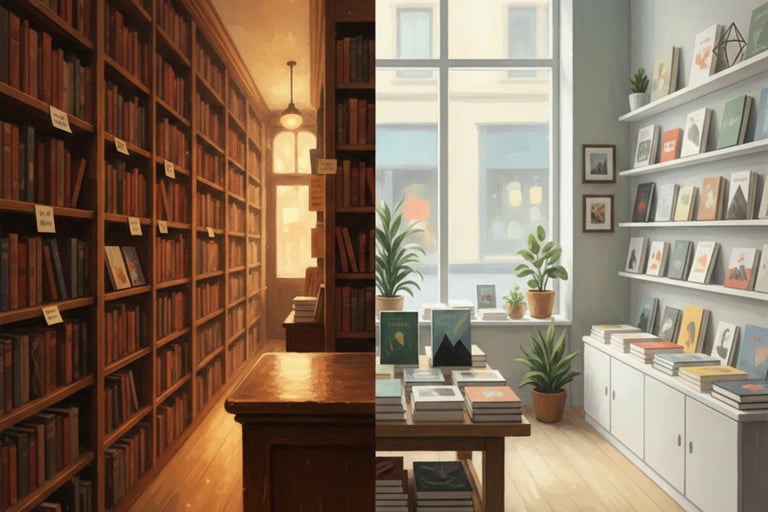
In my shop, the contrast was stark.
Her books were older, heavier, with spines that had been held by multiple hands. Mine were brighter, newer, arranged in clean lines meant to invite.
I watched her take in the space with a tight expression, as if she was forcing herself not to judge.
I wanted to tell her it wasn’t meant to replace Ruth’s shop. It was meant to survive alongside it.
But we weren’t there yet.
We fell into an unspoken agreement. I kept the front displays. She took the back area, and I cleared a spare counter for her without making her ask.
She looked at it, then at me, suspicion flickering.
I kept my face neutral.
A customer walked in, stopped, and turned slowly in a circle.
“This is interesting,” she said. “Like two bookshops in one.”
“Yes,” the other woman said tightly.
I pretended not to notice the tension and helped the customer browse. The woman ended up buying a book from my front table and one from the other shop’s back shelf.
When she brought them to the counter, the question arrived exactly as I’d feared.
“We should probably decide how to handle sales,” I said carefully. “If someone buys from both sections, do we split? Or—”
“Separate transactions,” she cut in.
I nodded immediately. “Okay.”
It wasn’t the answer that mattered. It was the way she said it, like she needed the boundary to stay solid.
So I didn’t push.
Over the next days, the shop became something like a shared house where two roommates refused to admit they lived together. We moved around each other carefully, communicating through functional sentences and cautious notes.
I asked before touching any of her stock. If I needed to shift something for airflow, I left a note.
Moved the poetry shelf to avoid the vent — hope that’s okay.
It wasn’t just politeness. It was respect.
Because the truth was, I admired what she was doing. The care. The devotion. The way she treated each book like a promise.
One afternoon, when she came in early, she found me sitting at the counter reading a stack of handwritten recommendation cards.
She stopped so abruptly I heard it.
I looked up quickly, caught, and cleared my throat.
“Your aunt wrote these?” I asked.
“Yes,” she said, guarded.
“They’re… beautiful,” I said quietly. “Like she was talking to the reader directly.”
Her expression shifted, throat tightening like she was holding something back.
“She did that,” she said. “She… liked people.”
I nodded, eyes back on the cards so she wouldn’t have to watch my face. “You can tell.”
After that, she started looking at me differently.
Not warmly, exactly.
But less like I was a threat and more like I was… complicated.
It was the smallest change, but it mattered.
I learned her name the same way I learned most things about people: through someone else.
A regular came in one rainy afternoon, cheerful, and called, “Elise! Oh honey, I’m so sorry about Ruth.”
The woman behind the counter stiffened for a moment, then softened.
“I’m okay,” she said automatically, and it sounded like a lie she’d practiced.
Elise.
The name suited her. Clear. Classic. Like a book you keep returning to because it doesn’t disappoint you.
Later, when the shop was quiet, I tried it in my mind. Elise. It felt like stepping closer without permission.
During the third week, the town’s curiosity turned into enjoyment. People started treating our shared shop like an event.
“It’s like you two planned it,” someone said, laughing.
Elise smiled politely, but her jaw tightened.
I watched her with a kind of reluctant tenderness. She looked like she was always bracing for impact.
I recognised it, because I did it too.
The difference was I’d learned to disguise it with polish.
She wore hers openly.
One evening after closing, we stood at the counter counting receipts. The street outside was slick and quiet. The shop felt too large with only the two of us inside.
I could feel the heat of her shoulder near mine, the steady rhythm of her breathing.
“This isn’t how I expected this to go,” I said, surprised to hear it out loud.
“Me neither,” she admitted.
I took a breath. The truth had been sitting in my chest for days, sharp and unsaid.
“I know you think I’m trying to outlast you,” I said.
Elise looked at me. “Aren’t you?”
My stomach tightened. The question wasn’t cruel. It was afraid.
“No,” I said, meeting her gaze steadily. “No. I think we’re doing different things. And I think there’s room for both.”
Her eyes narrowed slightly, as if trying to find the trick.
I wanted to explain it better, but I could feel how fragile the moment was.
“You don’t understand this place,” she said, and I heard the grief underneath. Not just the pride.
I nodded. “Probably not. But I’d like to.”
The words were honest in a way that scared me.
I half-expected her to shut down. To retreat behind that tight smile.
Instead, she just stared at me, like she wasn’t sure what to do with someone who wasn’t attacking.
That night, I went home and couldn’t sleep.
Not because I was thinking about business.
Because I kept seeing the way her hands had trembled when the water rose.
Because I kept hearing her voice when she said her aunt liked people.
Because I kept thinking about how Elise looked in the dim light of my shop, surrounded by books that belonged to her history, and how unfair it was that grief had dropped responsibility on her shoulders like a punishment.
The morning the flood repairs finished, I helped her carry the last boxes back across the street. The sun was out, bright and almost rude after weeks of rain.
Ruth’s Book Nook looked freshly cleaned, patched and repaired, stubbornly itself.
Elise stood in the doorway holding her keys like she didn’t quite trust them. I recognised that look: the moment when something ends, and you don’t know what you’re supposed to be without it.
I brought her a box of things she’d left in my back room: a stapler, a mug, receipts, the kind of small items that prove you were somewhere.
“You forgot these,” I said.
“Thank you,” she replied, taking the box.
We stood there, awkward in daylight.
“Good luck,” I said, and meant it.
“Thanks,” she said, then surprised me by adding, “You too.”
It hit me harder than it should have. Two words. Soft. Like a door opening.
“This doesn’t have to be… adversarial,” I said finally, voice careful. “Not if you don’t want it to be.”
Elise looked at me.
The street was quiet enough that I could hear my own heartbeat.
“I know,” she said.
The simplicity of it loosened something in my chest.
I nodded once, because I didn’t trust myself to say more without making it heavy.
I started to step away, then turned back because the truth wouldn’t stay quiet.
“And… I meant what I said,” I added. “About there being room for both.”
Elise swallowed. “Okay.”
I crossed back to my side of the street, the sun warm on my shoulders, and felt something like relief and something like sadness tangled together.
Because part of me wanted this rivalry. It was simpler to be the modern villain. It gave the street a story that made sense.
But the real story was messier.
It was grief on both sides.
A legacy in one shop and a second chance in the other.
And, increasingly, it was Elise.
That night, after closing, I looked out my front window at Ruth’s Book Nook.
Elise stood in her doorway for a moment, keys in hand, gaze lifted toward my lit windows.
When she noticed me watching, she didn’t look away.
She held my gaze.
It wasn’t a smile.
It wasn’t a confession.
But it was a choice.
And for reasons I couldn’t yet put into words, it felt like the beginning of something that had nothing to do with winning.
If you’d like the complete pair as a polished keepsake:
👉 Collector Edition on Etsy (both stories + bonus epilogue).
Contact
Questions or thoughts? Reach out anytime.
© 2025. All rights reserved.