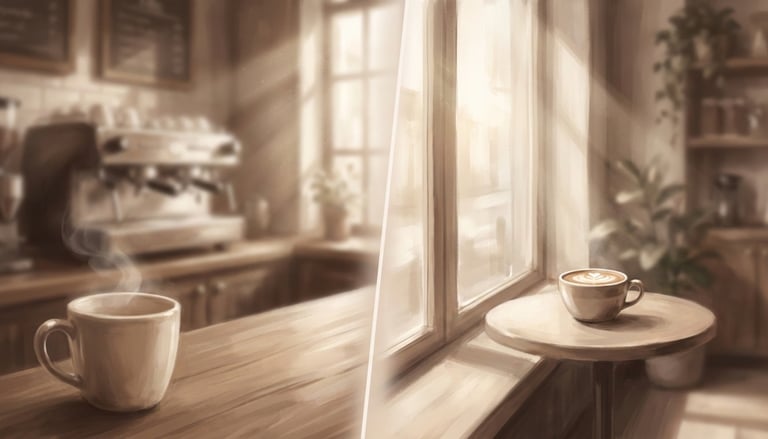
The Coffee Shop Regular
Story Two: Customer
Tuesdays and Thursdays have always been mine.
Not in a dramatic way. Not like a claim. More like a small hinge in the week that swings the right way when everything else feels stiff and heavy. I didn’t mean to build my life around a coffee shop. I didn’t mean to start counting time in two-day increments, to feel the week split into before three and after three.
But then she handed me a latte that tasted like someone had paid attention.
And my brain, which is excellent at finding patterns when it wants to be hopeful, decided it was a sign.
It was stupid, probably. It’s not like a barista can’t make a good coffee without it meaning anything. It’s not like someone can’t be kind because they’re kind.
But the first time she did it, I took a sip and my eyes actually widened, like a cartoon version of myself. There was this extra depth to it. This warmth. This richness that sat at the back of my tongue and made me close my eyes for half a second because it felt so unexpectedly… good.
Not just the taste.
The feeling.
Like the drink had been made for me, specifically, in a world that rarely tailored anything to fit.
I opened my eyes, and she was watching me.
Not staring. Not in a way that could be called creepy. Just attentive, like she cared whether I liked it. Like my reaction mattered.
Her name tag said Elise, and I remember thinking that the name matched her. Soft, a little shy. The kind of name you could say quietly.
I wanted to say something clever.
Instead I said, “Wow,” like an idiot.
Then, because I’m a person who was raised to be polite until politeness becomes a mask, I added, “Thank you.”
She smiled. Small and quick. And then she looked away like she’d done something wrong.
Which, of course, made my brain do what it always does when I’m given something nice without explanation.
It tried to tell me I didn’t deserve it.
So I told myself it was an accident.
A fluke.
A machine pulling funny.
Beans ground slightly different.
Anything except the simplest, most terrifying option: that it was deliberate.
Because deliberate would mean intention. And intention would mean attention. And attention would mean she’d noticed me the way I had started to notice her.
And that was a cliff I didn’t want to stand on without some sort of railing.
So I came back.
Not the next day. I didn’t want to look eager. I didn’t want to look like the kind of person who builds a routine around a stranger in an apron.
I came back on Tuesday at 3:00 pm, because that’s when my calendar gave me cover.
I made it sound responsible in my head.
A break between meetings. A chance to reset. A reward for surviving corporate nonsense until mid-afternoon.
All technically true.
But not the real reason.
The real reason was Elise.
Elise behind the counter, hair slightly messy, hands quick and sure as she worked the machine. Elise looking up when I walked in, her gaze flickering to my face for a fraction of a second before she looked away, like she didn’t want me to catch her catching me.
The first time I walked in and she was there, my stomach did something stupid, like I was fifteen again and not a grown woman with a job and a mortgage and an email signature that makes me sound more confident than I am.
I ordered the same thing because changing it felt like changing the script.
“Oat latte,” I said. “Medium. Extra hot, please.”
She nodded like she’d been waiting for me to say it.
And then she made the coffee.
And when I took the first sip, it had that same extra depth, that same wakeful warmth, like she’d quietly nudged my day into a better shape.
I sat at the window table because it felt safe. It let me be close without being obvious. It gave me something to look at that wasn’t her, so I didn’t have to monitor my face constantly.
And yet my eyes kept drifting to the counter anyway, drawn like there was a thread.
If I’m honest, it didn’t even start with attraction.
Not the usual kind.
It started with how she moved through her work like she was trying to be small and excellent at the same time. Like she’d learned that if you can’t be the loudest, you can at least be the most reliable. Like she’d been praised for being “easy” so often that she’d made it her whole shape.
I recognised it because I’d done it too, once. Before I learned to wear competence like armour.
There was a quietness to her that wasn’t emptiness. It was restraint. A carefulness that made me curious.
People are always telling you who they are in the way they handle the ordinary.
Elise handled the ordinary like it mattered.
So I kept coming back.
Tuesdays and Thursdays.
Three o’clock.
It became routine in the way brushing your teeth becomes routine, except it wasn’t hygiene. It was hope.
I started arranging my week around it without admitting it out loud. On Tuesday mornings, I’d look at my calendar and feel this small lift in my chest, like there was a prize waiting at the end of the day.
I would tell myself it was caffeine.
I would tell myself it was the quiet of the café.
I would tell myself it was the consistency of the latte.
And sure, those were perks.
But the truth was simpler.
I liked the way Elise said, “No worries,” like she meant it.
I liked the way she smiled when she handed me my drink, like it was something she was practicing.
I liked the way she sometimes looked up from the machine and I’d catch her gaze and for a half-second we’d exist in the same place, unarmoured.
Then she’d look away first.
Every time.
Which, of course, made my brain do the second thing it always does.
It tried to turn hope into humiliation.
She’s just being nice.
She doesn’t even remember you.
You’re a customer. You’re part of her job.
You’re imagining that little flicker in her eyes because you want something to be there.
So I kept my boundaries.
I didn’t flirt. Not really. Not like the women who could walk into a room and make the air change. I said “please” and “thank you.” I asked how her day was, like a normal human being, and then hated myself for caring too much about whether she answered in full sentences or the short, practiced script.
Sometimes she would answer normally, a little more than required.
“Busy, but good.”
“Not too bad.”
And I’d think, maybe she’s letting me in a fraction.
Then she’d step away, and the café would swallow her, and I’d feel ridiculous again.
It was manageable until the coffee itself became… too consistent.
Because if it was an accident, it should have varied.
If it was the machine, the beans, the barista training, then it should have changed at least once. Some days a little stronger, some days a little weaker.
But it didn’t.
It was always like that.
Always that extra depth. That extra warmth. That extra pulse under the taste.
After a while, the only explanation left was the one I’d been avoiding.
Elise was doing it on purpose.
And if Elise was doing it on purpose, the next question became unbearable.
Why?
The answer I wanted was simple.
Because she likes you.
The answer I feared was simpler.
Because she wants you to tip better.
Because she thinks you look tired and she pities you.
Because she does it for everyone and you’re not special at all.
I tried to convince myself to stop thinking about it.
I tried to convince myself to go to a different café.
I tried, once, on a Saturday, to test it. I went to another place across town. I ordered the same oat latte, extra hot, and it tasted fine. Good, even.
But it didn’t taste like care.
And I found myself annoyed at the barista for no reason at all, which was both unfair and deeply telling.
So I went back on Tuesday at three.
Because, apparently, I am the kind of woman who will rationalise anything if it gives her a sliver of a feeling she hasn’t had in a while.
It wasn’t just the coffee shop. It was my life outside it.
My work is not tragic. It’s not dramatic. But it is relentless. It’s meetings that could have been emails. It’s office politics. It’s the constant low-grade performance of being “fine” and “capable” and “definitely not quietly lonely.”
And then, at three o’clock twice a week, I could walk into a café and be a person again.
A person with a drink in her hands.
A person who gets a small kindness without needing to earn it.
A person who gets to look at Elise and wonder, for a moment, if the world could be softer.
For a while, that was enough.
Then, on a rainy Thursday, it wasn’t.
It was raining in that thin, annoying way that makes you feel damp even if you have an umbrella. I walked in, shook out my coat, and looked up.
Elise was there, behind the counter, hair a little darker at the ends from the humidity. She glanced up and our eyes met.
That half-second hit me like it always did.
Except this time, something in me shifted.
Maybe it was the rain. Maybe it was exhaustion. Maybe it was the way she looked like she was carrying the day on her shoulders and I wanted, suddenly, to take some of it.
Or maybe it was just that I was tired of living in the safe space between wanting and never asking.
I ordered my latte like usual, then hesitated, the words rising in my throat before I could stop them.
“Actually,” I said, and Elise’s hands paused.
She looked up, cautious.
“Can I ask you something?”
Her expression changed subtly. Not alarm. Not annoyance. Just… alertness. Like she was bracing herself.
“Sure,” she said.
I felt my heart beat harder. My palms were suddenly damp.
Do it. Say it. Don’t make it weird. It’s just a question.
But it didn’t feel like “just” anything.
“Do you…” I began, and then my brain tried to yank me backwards, screaming abort, because the risk suddenly felt enormous.
Elise waited.
I forced myself through it.
“Do you always make it like this?”
Her face went still. Not in a blank way. In a careful way. Like she was picking which version of herself to show me.
“Like what?” she asked.
I laughed, embarrassed, because of course it sounded ridiculous out loud.
“I don’t know,” I said. “It just… tastes different here. Better.” I rushed, “Sorry. That sounded like I’m complaining. I’m not. I just… I look forward to it.”
There.
I’d said it.
Not the full truth, but enough of it that my pulse fluttered like a trapped bird.
Elise’s gaze flickered to my face, then away.
She shrugged, light and dismissive.
“We use good beans.”
The words landed like a cold spoon.
Not because they were rude.
Because they were safe.
Because they were the kind of answer you give a customer you don’t want to encourage.
My face stayed polite. My smile stayed intact. I am excellent at smiles that do not reveal what I’m doing internally.
“Oh,” I said lightly. “Right.”
She handed me the cup, and our fingers brushed.
The brief contact sent a jolt through me so sharp my stomach flipped.
Then she pulled away, like she didn’t trust herself to keep touching.
Which made no sense.
Which made my mind spin.
Because if she didn’t want me, why would her hands tremble?
I took my latte to the window table and tried to read a book. I tried to let the pages absorb my thoughts the way they normally do.
But I couldn’t stop replaying that moment.
Her pause.
Her stillness.
The way her eyes had widened a fraction.
The way she’d answered too quickly, too neatly.
Like she’d been afraid of something.
I watched her from behind the cover of my book, like a creep, and saw her wiping the same spot on the counter again and again, like she needed something to do with her hands.
A warm, stupid thought unfurled in me.
Maybe she’s scared too.
Then my brain, always ready with the knife, offered its counterpoint.
Or maybe she’s uncomfortable because you’re being weird.
So I went home and told myself I would stop.
I told myself I would find another café.
I told myself I would not allow a barista to become the anchor point of my week, because that is the kind of thing sad women do in movies.
Then, Friday afternoon, my mother called.
When you have a mother like mine, you learn to recognise the tone before the words. That brittle brightness, like she’s trying to make the world look normal through sheer will.
“Mara,” she said, and I knew instantly that something had happened.
Two hours later, I was in a car on the highway, my phone buzzing with messages from my sister, my mind running through worst-case scenarios like it could prepare me.
It was my uncle. Not dying, but close enough that the word hospital pulled all the air out of my lungs anyway. The family politics around him were its own kind of trauma. There were people I hadn’t seen in years who would suddenly expect me to become the version of myself they remembered. There were conversations waiting that I’d been avoiding.
I didn’t have time to think about coffee.
I didn’t have time to think about Elise.
And yet, on Tuesday at 2:59 pm, I found myself checking the time on my phone in the hospital corridor and feeling my throat tighten.
Because somewhere, in another city, a café bell would be ringing.
And Elise would be behind the counter.
And I would not be there.
The thought felt absurdly painful.
Like grief, but small.
Like losing a thing you never officially had.
I stayed out of town for longer than I expected.
Family stuff is rarely quick. It stretches. It tangles. It drags you through old versions of yourself and dares you not to drown.
By Thursday, I was exhausted. By the next Tuesday, I was running on caffeine and resentment and obligation. By the next Thursday, I was so tired I could barely hold a conversation without wanting to cry.
And still, twice a week, my mind returned to that café.
To Elise’s hands.
To the way her eyes had flickered to mine.
To the way my latte had tasted like care.
I told myself it was escapism. A harmless daydream.
But it wasn’t just that.
It was the fact that I had asked a question and gotten a safe answer, and the safe answer had lodged in my chest like a splinter.
We use good beans.
It’s not personal.
Stop making it personal.
And yet, the memory of her pause contradicted it.
So I made a decision in the hospital parking lot on the following Sunday, while my sister smoked a cigarette she didn’t even want, while the sun set behind the building like it was trying to be beautiful as an apology.
I decided that when I went back, I wouldn’t hide behind routine anymore.
Not completely.
I would apologise for disappearing, because I couldn’t stand the thought of her thinking I’d simply stopped.
And I would… do something.
I didn’t know what.
Ask for her name?
Ask if she wanted to get a drink sometime?
Ask if she knew she was the reason I rearranged my calendar?
All of it felt too big and too small at the same time.
But I knew one thing.
If I didn’t act, I would keep living inside this loop, feeding myself tiny hopes and then starving in the silence between them.
And I was tired of starving.
Tuesday came, and I wasn’t back yet. Work had piled up while I was away. My inbox looked like a threat. I couldn’t escape at three. I couldn’t even pretend.
I told myself it didn’t matter.
Then Thursday arrived, and something in me snapped.
Not in a dramatic way. Just a quiet decision.
I moved my 2:30 meeting. I lied about a scheduling conflict. I left the office earlier than I could justify. I walked through the city like my feet were trying to get there before my courage ran out.
By the time I reached the café, my heart was pounding so hard I could feel it in my jaw.
It was ridiculous. It was coffee. It was a barista. It was a crush I’d nurtured in secret like a houseplant.
But as I stood outside, hand on the door, I realised the stakes weren’t really about Elise.
They were about me.
About whether I was going to keep living like my feelings were something to hide.
I pushed the door open.
The bell chimed.
And there she was.
Behind the counter.
Hair messy in the way I’d missed without realising how much. Hands moving quickly, competent, sure.
She didn’t look up right away.
Then she did.
And her face changed.
Not dramatically. Not obviously. But I saw it because I’d become fluent in her micro-expressions the way you become fluent in weather when you live somewhere unpredictable.
Her eyes widened.
Her posture went still.
Like she had been waiting for this moment and hadn’t wanted to admit it to herself.
The sight hit me so hard my throat tightened.
I stepped forward before I could back out.
“Hi,” I said.
“Hi,” she replied, voice quiet, almost stunned.
My chest hurt with relief, with fear, with something warm and desperate.
“I’m sorry,” I said immediately. “I didn’t mean to… disappear.”
Her face stayed careful, but her eyes softened.
“It’s… okay,” she said, and it sounded like a lie meant to be kind.
I rushed on, needing her to understand.
“I had to go out of town. Family stuff. It was sudden.”
“Oh,” she whispered. “I hope everything’s alright.”
“It is now,” I said, because it was. Not perfect, but stabilised. Contained.
I hesitated, then admitted the part that had been clinging to me for two weeks like a thread.
“I kept thinking about… this place. About coming back.”
Her gaze sharpened, like the words mattered.
I swallowed.
And then, because I was here and because I couldn’t bear to keep pretending the truth didn’t exist, I said it.
“I come in because of you.”
The silence that followed was so clean it felt like stepping into a new room.
Elise stared at me like I’d handed her something she didn’t know how to hold.
I watched her face for rejection.
For discomfort.
For the gentle smile of a service worker turning down a lonely customer.
Instead, her eyes flickered with fear and something else. Something that looked a lot like longing.
“I…” she started, then stopped.
I panicked, words spilling out too fast.
“Sorry. That sounded too much. I just meant, I like seeing you. Talking to you. Even if it’s just… coffee.”
“Coffee,” she echoed, and her voice did something strange, like it wavered.
Then she said, quietly, “I noticed.”
My stomach dropped.
“You did,” I repeated, disbelief cracking my voice. “You noticed I wasn’t here?”
She looked almost alarmed, like she regretted admitting it. Then she exhaled, defeated by honesty.
“I mean,” she said quickly, “you come in regularly. Tuesdays and Thursdays. It’s…”
It’s you, I thought, but she didn’t say it.
Maybe she didn’t think she was allowed.
My chest tightened with the familiar ache of recognition.
Because I knew that feeling.
I knew what it was like to want and not believe you had permission.
I looked at her, really looked, and saw the tension in her shoulders, the way she was gripping the edge of the counter like she needed it to keep steady.
And something in me softened, as if the crush had shifted into something more tender.
“Elise,” I said, then realised I’d never actually said her name out loud before. It felt intimate in my mouth.
Her gaze lifted, startled.
I took a breath.
“I always thought you were just being nice,” I admitted. “Like you had to be. And then I told myself I was imagining the… difference.”
Elise’s lips parted slightly.
“You weren’t imagining it,” she said, so softly it almost disappeared.
My heart kicked hard.
I watched her face, searching for the line where she might pull back.
She didn’t.
She looked at me with a steadiness that felt like bravery.
And then she said, before I could second-guess everything again:
“I thought I’d scared you off.”
The words hit me with a shock of sadness.
“What?” I whispered.
She swallowed, eyes flicking away, then back.
“Last time,” she said, “you asked if I always make it like that. And I… I gave you a stupid answer.”
It was so human, that admission. So earnest. It cracked something open in me.
“It wasn’t stupid,” I said.
“It was,” she insisted, cheeks flushing. “Because I wanted to say something else.”
I heard myself ask, “What did you want to say?”
The café noise blurred. My whole attention narrowed to the space between us, to the way her hands trembled faintly under the counter, to the way her breath hitched.
“I wanted to say,” Elise whispered, “that I look forward to it too.”
For a second, I couldn’t move.
Then relief flooded me so hard I actually felt dizzy.
“Oh,” I breathed, and it came out like a prayer.
She looked at me, still half terrified, as if she didn’t trust the safety of this moment.
I smiled, the kind of smile that feels like stepping into warmth after being cold for too long.
“I do,” I admitted. “I look forward to it all week.”
Elise let out a shaky laugh, and it made something inside me melt.
Then, because the truth was finally within reach and I couldn’t stop myself, I asked the question that had been hovering in the background for months like a ghost.
“Is the extra shot… on purpose?”
Elise went red so fast it was almost adorable.
For a moment, she looked like she might deny it. Like her fear might win.
Then she nodded, small but clear.
“Yes.”
The laugh that burst out of me was pure, delighted disbelief.
“Oh my god,” I said, and the words felt stupid, but I couldn’t find anything else.
Elise started apologising immediately, words tumbling out.
“I didn’t want to make it weird, I just… I noticed you liked it that way and then it became a thing and then I couldn’t stop and—”
Before I could think too hard, I reached out and touched the back of her hand.
Light. Careful.
Her skin was warm under my fingers.
The contact made her go still, like she’d been starved for gentleness.
“It’s not weird,” I said. “It’s… sweet.”
She looked at me like I’d said something impossible.
Like sweetness wasn’t a thing she got to be.
There was a pause.
Then I realised something, sharp and clear.
Elise wasn’t rejecting me.
She was afraid.
Afraid of being wrong. Afraid of overstepping. Afraid of wanting.
The same fear that had kept me polite and contained at her counter for weeks.
So I took a breath and decided to be the one who moved first.
“Would it be completely unhinged,” I asked, “if I asked you to sit with me for five minutes?”
Elise’s instinctive answer was, “I’m working,” but I could see how much she wanted to say yes anyway.
I watched her glance toward her coworker.
The coworker, bless her, made a very obvious go-on gesture like she was directing an orchestra.
Elise untied her apron with trembling fingers.
“Five minutes,” she said. “Yeah.”
The relief that surged through me felt like I might laugh or cry. I chose a smile and walked toward the window table before my courage could evaporate.
When she sat opposite me, she looked different without the counter between us. More exposed. More real.
The café light caught her face and made her look softer. Younger. Like someone who had spent too long trying to be invisible.
I took a sip of my latte as if it were a ceremony.
“Still perfect,” I said.
Elise blushed.
Then I did the thing that felt like handing over a key.
“I’m Mara,” I said.
Her breath caught.
“Mara,” she repeated, and the way she said it made my chest ache.
“I’m Elise,” she offered, like she hadn’t already been living in my head for months.
“Elise,” I said, letting myself taste it properly now.
We sat in a pause that was full rather than empty.
Then Elise asked, “You really thought you were imagining it?”
I let out a quiet laugh.
“I thought I was being ridiculous,” I admitted. “I thought you were just… professional.”
Elise’s mouth twisted.
“I thought you were just… polite,” she confessed.
And there it was.
Two women standing on opposite sides of the same invisible wall, pressing their palms against it, waiting for the other to prove it was real.
I looked at her, feeling suddenly brave in a way that didn’t feel like performance.
“I disappeared and I hated it,” I said. “Not because I missed the coffee. Because I kept thinking… you might think I just stopped.”
Elise’s gaze softened.
“I did think that,” she admitted, voice quiet. “And I told myself it didn’t matter.”
“It mattered,” I said.
The words sat between us, simple and heavy.
Elise’s hands were in her lap, fingers twisted. I wanted to reach across the table and untangle them gently, but I didn’t want to rush.
So instead, I gave her what I wished someone had given me when I was younger.
Clarity.
“I’m trying,” I said softly, “to stop treating my feelings like a private embarrassment.”
Elise’s eyes flickered, and something in her expression looked like recognition so sharp it bordered on pain.
“And,” I added, because truth was the only thing that had gotten us here, “I’m trying to figure out if you’d ever want to see me when you’re not being paid to.”
Elise blinked.
Then, like the answer had been waiting behind her teeth for months, she said, simply:
“Yes.”
The word hit me like sunlight.
“Yeah?” I asked, because hope always makes me suspicious.
Elise nodded. “Yeah.”
The breath I’d been holding since the rainy Thursday I’d asked my question finally left my body.
“Oh,” I whispered, smiling despite myself. “Okay. Good.”
Elise looked at me, something fragile and bright on her face.
And I realised that she didn’t know how wanted she was, not just by me, but by the universe in general. Like she’d been living as if she were optional.
It made me want to be careful with her.
I decided, in that instant, that whatever this was, I would not treat it like a joke.
“Can I give you my number?” I asked.
Elise said, “Yes, please,” and the politeness of it made my heart twist.
I slid my phone across the table and watched her type, hands shaking.
When she handed it back, our fingers brushed, and this time the contact lingered for half a beat longer.
“I’ll text you,” I promised.
Elise nodded, eyes wide like she couldn’t quite believe she was allowed to want this.
“If you’re free after your shift,” I added, voice lighter now, “maybe we could go somewhere that doesn’t smell like espresso.”
Elise laughed softly.
“I’d like that,” she said.
I glanced toward the counter, knowing she’d have to go back soon. I didn’t want to let the moment collapse into goodbye without anchoring it to something solid.
So I asked, “Same time Thursday?”
Elise’s expression softened into something that looked like home.
“Thursday,” she echoed. “Three.”
I smiled, the kind of smile that feels like the beginning of a habit you actually want.
Before I stepped away, I leaned in, careful not to invade her space, and said, so quietly the world couldn’t steal it from us:
“I’m really glad you noticed.”
Then I left, heart pounding, hands trembling, and walked out into the afternoon like I wasn’t carrying something fragile and bright in my chest.
By the time I reached the corner, my phone was already in my hand.
I texted her before I could talk myself out of it.
Hi Elise. Just making sure this is real and I didn’t hallucinate you coming to sit with me ☕🙂
I paused, then added, because I couldn’t help myself:
Also: your extra shot should be illegal.
I laughed at my own ridiculousness and kept walking.
A moment later, my phone buzzed.
Real. And you didn’t hallucinate the extra shot either.
My chest warmed.
Another message came through.
See you after my shift?
I stopped walking.
Just… stopped, right there on the footpath, because the simplicity of it knocked the wind out of me.
I typed back with hands that didn’t feel steady.
Yes.
Then, because I wanted to be brave, because I wanted this to be a story where we didn’t keep waiting for the other person forever, I added:
And Elise?
The little three dots appeared instantly.
I smiled, absurdly.
And I wrote the truth, the one that had been quietly rearranging my life for weeks.
I look forward to it.
When I put the phone away, the city looked exactly the same. Cars. People. Noise. Normal life.
But inside me, something had shifted.
The routine wasn’t mine anymore.
It was ours.
And for the first time in a long time, I wasn’t using routine as a shelter.
I was using it as a doorway.
Prefer the keepsake version?
The Collector Edition PDF includes both POVs plus a bonus epilogue you won’t find anywhere else.
👉 Get the Collector Edition on Etsy here.
Contact
Questions or thoughts? Reach out anytime.
© 2025. All rights reserved.