The Apartment Above
Two Sides Of The Same Story
TWO SIDESSHORT STORY
12/29/20257 min read
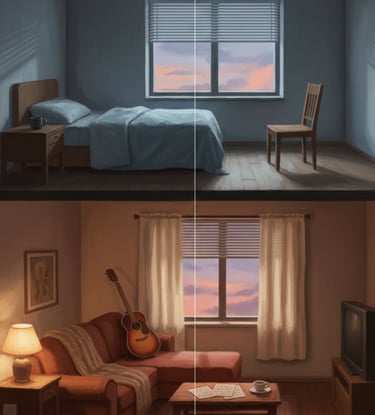
Story One: The Musician
The first note I ever played in this apartment was an apology.
Not out loud. Not yet.
It was just a test — a soft press of fingers against strings, barely more than a breath — the kind of sound you make when you’re checking whether the walls are thin or you’re just imagining it.
They were thin.
I learned that quickly.
The building was old in a way that felt personal, like it had been built with the assumption that everyone inside it would live quietly. Narrow hallways. Floors that remembered footsteps. Pipes that knocked in the night like they were trying to get your attention.
I moved in on a Tuesday afternoon with two suitcases, my guitar, and the kind of optimism that comes from believing a fresh start will fix things you haven’t named yet.
I told myself I wouldn’t play late.
I told myself I’d practice during the day, when people were at work, when noise was expected.
I told myself a lot of things.
The first week, I held to it. Played in short bursts. Stopped whenever I thought the sound might carry. Sat on my bed and strummed muted strings, listening more than playing.
On the eighth night, my hands moved without asking permission.
It was close to midnight — that soft, suspended hour where everything feels heavier because you’re tired enough to stop guarding yourself. I was sitting cross-legged on the floor, guitar resting against my knee, when a melody I’d been circling for weeks finally settled.
I didn’t think.
I played.
Just a little louder than a whisper. Just enough to hear the shape of it.
When I finished, the silence afterward felt too loud.
I sat there, heart hammering, waiting for a knock that didn’t come.
The next morning, I found the note.
It was taped neatly to my door, the handwriting careful and precise, like the person had taken their time.
Hey — I think you might be new?
Just wanted to let you know the walls are thin.
No worries, just a heads-up.
— Upstairs
No smiley face. No exclamation point. Polite. Neutral.
Reasonable.
My stomach dropped anyway.
I stared at it longer than necessary, heat creeping up my neck. Of course someone had heard. Of course I’d misjudged. Of course I’d been a problem before I’d even unpacked fully.
I pulled the note down, folded it once, and slid it into the pocket of my jacket like it was something I needed to keep.
I spent the rest of the day not playing.
That night, I wrote back.
I found a sticky note in the kitchen drawer — bright yellow, impossible to miss — and wrote carefully, trying to make my handwriting look less like it belonged to someone who lived alone with too many thoughts.
Hi — yes, I’m new.
I’m really sorry about the noise. I play guitar, but I’ll keep it earlier / quieter from now on.
Thanks for letting me know.
I paused, then added:
Promise.
I stuck it to their door, pressed it flat, and walked away quickly, like proximity might make the guilt louder.
For a while, things were fine.
I practiced during the day. Or at least what counted as day in my life — late mornings, early afternoons. I learned the rhythms of the building: when the pipes rattled, when the front door slammed, when someone upstairs dragged furniture like they were rearranging their life at two in the morning.
I assumed Upstairs worked normal hours.
I assumed a lot.
The thing about music is that it doesn’t respect the rules you make when you’re calm.
Songs don’t arrive on schedule. They come when you’re half-asleep, when you’re raw, when your guard is down enough that you stop filtering yourself.
I tried to ignore them when they came late. Tried to write them down instead, fingers cramped around a pen, capturing fragments I couldn’t play yet.
It wasn’t the same.
The first apology note I left after that wasn’t even for noise.
It was for silence.
Sorry if you can hear me pacing.
Apparently, my brain thinks 2 am is a great time to solve everything.
I hesitated, then added a small, self-deprecating smiley face before I could talk myself out of it.
I expected nothing back.
But the next day, there was another note.
Same careful handwriting.
Pacing is fine.
I work nights — I’m usually awake anyway.
I stared at the words, something warm and unexpected unfurling in my chest.
Usually awake anyway.
That changed things.
Not immediately. Not dramatically.
But enough that when the music came late again — a soft melody, careful and restrained — I didn’t stop myself as quickly.
I played like I was holding my breath, shaping the song so it stayed gentle. Letting it taper instead of swell. Ending before it could become a complaint.
The next morning, there was no note.
Relief settled over me like a blanket.
A few days later, I found one waiting.
That song last night —
It sounded unfinished.
In a good way.
I sat on my bed and laughed, a startled sound that felt too big for the room.
They’d listened.
Not overheard. Not tolerated.
Listened.
I wrote back before I could second-guess it.
It was unfinished.
I got nervous halfway through.
This time, I didn’t add a smiley face.
Their reply came the next day.
It didn’t sound nervous.
I read that line so many times I worried it might blur.
After that, the notes became a quiet exchange — never long, never invasive, always careful. Like we were both walking along the edge of something we didn’t want to name.
I learned they worked nights at the hospital. That they slept during the day, but lightly. That they liked their coffee strong and their words measured.
They learned I played guitar. That I wrote songs I didn’t always finish. That I apologised too much.
Sometimes I’d leave a note after playing late.
Sorry if that was too loud.
Sometimes they’d leave one first.
You don’t need to apologise for existing.
That one stayed taped to my fridge for a long time.
I never saw them.
Not really.
Once, I caught a glimpse of someone heading up the stairs just as I was coming in — shoulder bag, dark jacket, hair pulled back — but they were gone before I could decide whether to say something.
I told myself it was better this way.
Safer.
I told myself they were being kind because they were kind to everyone.
That the listening didn’t mean anything beyond convenience.
Still, I found myself timing my playing.
Not to avoid them — but to catch them.
If they worked nights, that meant they were awake late. I started noticing when the building quieted in a particular way, when the ambient noise dropped low enough that my guitar would carry upward cleanly.
I played then.
Not louder.
Just… truer.
I started shaping songs like letters. Leaving space where a response might live. Ending on notes that felt like questions.
I never wrote lyrics. That felt like too much.
But the melodies learned how to say things I wasn’t brave enough to.
One night, after a particularly fragile session, I left a note without thinking.
That one was about feeling like a burden.
I stared at it, panic spiking, then added quickly:
— not you. Just… in general.
I nearly tore it down again.
I didn’t.
The reply came the next evening.
I don’t hear a burden.
I hear someone trying.
My hands shook when I read it.
After that, I started to wonder what it would be like to meet them.
The thought terrified me.
What if they were disappointed? What if the ease only existed because we were safely separated by floors and paper and sound?
What if seeing me made the music smaller?
So I stayed where I was.
Played when it felt right. Apologised when I needed to. Wrote songs that bent around the shape of someone I didn’t know but somehow trusted.
Until the night the music stopped.
It wasn’t intentional at first.
I’d come home late, exhausted in a way that settled deep into my bones. My guitar stayed in its case. My fingers ached. The melody that usually waited for me was quiet.
I told myself I’d play tomorrow.
Tomorrow came and went.
Then another night.
The silence stretched.
I noticed it the way you notice a missing tooth — suddenly, painfully, impossible to ignore.
I paced. I sat. I picked up the guitar and put it back down again.
I didn’t leave a note.
I didn’t know how to explain absence.
On the third night, there was a knock.
Not a note.
A knock.
Soft. Careful.
My heart slammed into my ribs.
I stood frozen in the middle of my living room, every instinct screaming at once.
The knock came again, tentative but present.
I took a breath, crossed the room, and opened the door.
She stood there looking almost apologetic for existing — dark jacket, tired eyes, posture careful in a way I recognised immediately. Not imposing. Not annoyed. Just… present.
“Hi,” she said.
The sound of her voice startled me more than the knock had.
“Hi,” I managed.
For a moment we just looked at each other, the distance between notes and paper and floors collapsing into something awkward and very real.
“I hope this is okay,” she said. “You haven’t been playing. I just wanted to make sure you were alright.”
Something in my chest loosened.
“I’m okay,” I said. “I just… went quiet.”
She nodded, like that made sense. Like quiet wasn’t a failure.
“I didn’t know if the music was too much,” I added, the words tumbling out before I could stop them. “I didn’t want to be—”
“A problem?” she offered gently.
I swallowed. “Yes.”
She shook her head immediately. “It wasn’t. It isn’t.”
The certainty in her voice caught me off guard.
“You can play anytime,” she said. “Really.”
I stared at her, trying to reconcile that with all the apologies I’d written, all the careful restraint I’d wrapped myself in.
“I didn’t realise anyone was really listening,” I admitted.
She met my gaze, something steady and warm there. “I was.”
That was all she said. No explanation. No expectation.
Just truth.
Something shifted then — not dramatically, not all at once — but enough that the silence I’d been carrying finally eased its grip.
“I might finish it,” I said softly. “The song.”
A small smile touched her mouth. “I’d like that.”
When she turned to leave, I stood there a moment longer than necessary, door still open, listening to her footsteps retreat up the stairs.
The apartment felt different when I closed the door.
Not quieter.
Held.
That night, I took my guitar out of its case and rested it against my knee. I didn’t play right away. I let the room settle around me first.
Then, slowly, carefully, I began again — not apologising, not hiding — just playing.
And for the first time since I’d moved in, the music didn’t feel like something I was inflicting on the world.
It felt like something I was sharing.
If you want the night shift neighbours side, you can unlock it by joining the newsletter. Subscribers get access to a private library of “Two Sides of the Same Story” pairings (plus the newsletter vault).
👉 Join here to read the other side.
Or, if you’d like the complete pair as a polished keepsake:
👉 Collector Edition on Etsy (both stories + bonus epilogue).
Contact
Questions or thoughts? Reach out anytime.
© 2025. All rights reserved.