The Bookshop Rivals
Every love story has more than one truth.
TWO SIDESSHORT STORYROMANCE
1/3/202612 min read
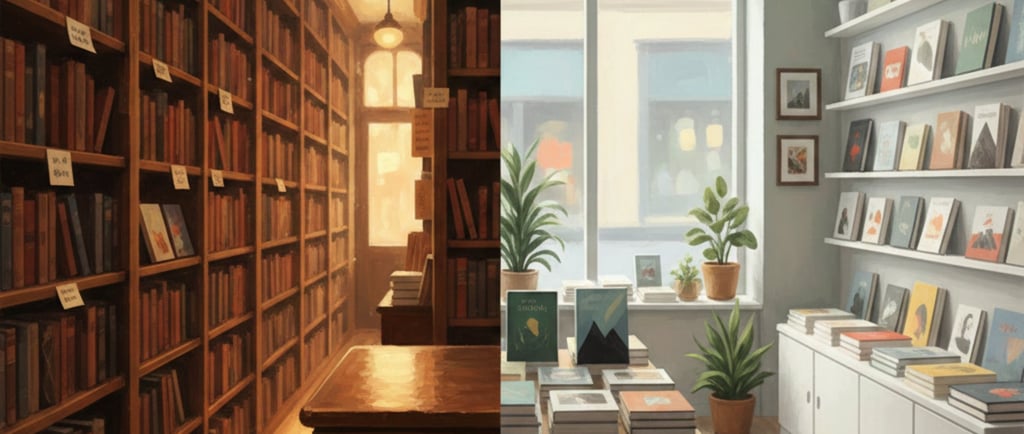
The Bookshop Rival
Story One: The Shop on the Corner
I inherited the shop on a Tuesday, which felt like my aunt’s sense of humour reaching out from wherever she’d gone. Tuesdays are quiet days. They don’t pretend to be anything grand. They just arrive, steady and unglamorous, and ask you to do what needs doing.
The solicitor’s office smelled like printer ink and stale peppermint tea. He slid the papers across the desk with the practiced solemnity of someone who dealt in other people’s turning points for a living.
“It’s all very straightforward,” he said. “Your aunt was meticulous.”
I nodded, because of course she was.
My aunt Ruth believed in neat margins and sharpened pencils. She believed the world made more sense if you put everything back where it belonged. She could catalogue an entire shelf by feel, fingertips grazing spines like she was reading a language only she spoke.
Her bookshop had been on that corner for forty-three years. Half the town had grown up inside it, even if they didn’t realise it. People wandered in for gifts, for comfort, for a place to hide for fifteen minutes from whatever was happening outside.
And now it was mine.
The solicitor handed me the keys and said something about insurance policies and business accounts and my responsibilities as the new owner. I caught maybe every third word. The rest slid off my brain like water.
All I could think was: I don’t know how to be the person she trusted with this.
Outside, the street had that late-morning brightness that makes everything look cleaner than it is. I stood on the footpath, keys cold in my palm, staring at the shopfront like it might blink at me and ask what I was doing.
The sign above the door was faded in places, paint peeling at the edges. Ruth’s Book Nook. She’d refused every suggestion to modernise it. “If people can’t read that,” she’d said, “they don’t deserve to come in.”
The bell chimed when I pushed the door open, the sound instantly familiar. The air inside was cooler than outside, thick with the scent of paper and dust and lemon polish. It hit me like a memory, sharp and gentle at the same time.
I shut the door behind me and just stood there.
The shop was quiet, but not empty. It held itself, the way old places do, as if it didn’t need you to be alive to remain real. The counter was scuffed and worn smooth where countless hands had rested. The aisles were narrow, forcing you to move slowly. Even the light felt deliberate, filtered through the front window and softened by time.
I walked to the back and touched the old wooden shelves, fingers trailing along the grain. Ruth had built some of these herself. She’d told me once, over a cup of tea, that she’d liked the work because it gave her something solid to do while she thought.
Ruth was a thinker.
So am I.
That’s the problem.
I turned and looked through the front window.
Across the street, the other bookshop was already open.
It hadn’t always been there. That space had been a florist when I was younger, then a café with mismatched chairs and a chalkboard menu that kept changing without ever finding the right customers. Five years ago it became a bookshop, and the street shifted around it as if forced to acknowledge something new.
Her shop.
Wide glass windows. Bright displays. Books face-out like they were art. A sleek sign with modern lettering that looked like it belonged on a website rather than on a street where everyone still used cash for small purchases.
I’d seen her before, of course. You couldn’t live in a town this small and not notice a woman who rearranged her front display like she was choreographing a scene. She stood in the doorway sometimes with a coffee in hand, watching people pass, looking like she’d chosen this place on purpose.
My aunt had called her “that glossy one,” with the faintest curl of disdain.
“As if books need to be sold like shoes,” Ruth had muttered once.
I’d smiled and agreed, because agreeing felt like loyalty.
But the truth was, the new shop had always unsettled me for a different reason.
It wasn’t just competition.
It was that it made me feel like Ruth’s shop could be replaced.
That the history I loved so much wasn’t an anchor, just an aesthetic.
The first week after the funeral, I went back to work in the shop because I didn’t know what else to do with my grief. I swept, dusted, and reorganised shelves that didn’t need reorganising. I drank tea from Ruth’s old chipped mug and pretended that holding the routine would hold me too.
People came in, quietly at first. Regulars who looked around as if expecting Ruth to step out from the back with a cardigan draped over her shoulders and a sharp opinion on whatever book they were carrying.
“I’m so sorry,” they’d say.
I’d nod. Smile. Thank them. Not cry, because crying felt like letting the shop become a place of death instead of life.
And then one afternoon, a woman I didn’t recognise wandered in, hesitated in the doorway, and said, “Oh… I thought this place closed. I usually go over there now.”
Over there.
Across the street.
I swallowed the sharpness that rose in my throat and said, “We’re still open.”
She looked relieved, as if she’d stumbled upon a secret. “That’s good. I like the smell in here.”
I smiled, because that was the kind of compliment Ruth would’ve liked.
After she left, I stood behind the counter and stared at nothing for a long time.
That evening, I stayed open later.
The next day, I came in earlier.
I restocked the front display with books Ruth would’ve approved of. I wrote little handwritten recommendation cards like she used to, even though my handwriting looked younger, less sure. I cleaned the windows until my arms ached.
Across the street, her windows changed weekly. Sometimes daily.
I told myself it was shallow.
I told myself she was chasing attention instead of building loyalty.
I told myself Ruth’s shop had a soul and hers was just curated.
And because this town is small and petty details travel like weather, I started hearing things.
“She’s got an author event next month.”
“She sells coffee too now.”
“Her website is really good.”
I hated how much that bothered me, because it wasn’t her fault. She hadn’t stolen anything from me. She’d opened a shop and apparently done it well.
Still, every time I saw her across the street, laughing with customers, I felt something tighten in my chest.
Like she was trying to outlast me.
Like she was waiting for Ruth’s old shop to fade into quaint irrelevance so she could inherit the whole street.
We never spoke.
Not properly.
Sometimes we nodded. A brief, tight politeness. A smile that didn’t reach the eyes.
Once, I caught her looking at Ruth’s shopfront for longer than necessary. When our eyes met, she looked away quickly, as if caught.
It annoyed me more than it should have.
Then the rain came.
It started as a steady drizzle and built into something relentless. The kind of rain that doesn’t fall so much as press down, insisting on being noticed. It lasted for days, swelling the gutters, turning the street into a dull ribbon of reflected grey.
On the fourth day, I smelled it before I saw it.
Damp.
It crept into the shop like a quiet intruder, sour and wrong, and when I followed it to the back corner my stomach dropped.
The floorboards were darkening. The wall behind the shelves looked bruised.
Water.
My hands went cold.
Ruth’s shop had always had its quirks, but she’d kept it standing through sheer stubbornness. “It’ll outlast me,” she’d said once, half-proud, half-accusing.
And now it was failing on my watch.
I moved fast. Too fast. Books came off shelves in frantic armfuls, stacked on the counter, on chairs, on any surface that wasn’t the floor. I called the emergency line and tried to sound calm while my heart hammered like it wanted out.
By the time I found buckets and towels, the water had spread, thin and glossy, creeping across the floor like it owned the place.
I was halfway through dragging a crate of older stock out of the danger corner when the power cut out.
The lights blinked, then died.
For a moment, the shop felt like it had gone under water too. Quiet. Heavy. Held.
Then I heard the doorbell.
The bell chimed, absurdly cheerful in the gloom.
I looked up, breath catching.
She stood in the doorway, rain-soaked, hair damp against her cheeks, eyes wide as she took in the scene. Her coat was dark, but water beaded on it like little mirrors.
“Oh,” she said. “That’s… bad.”
The irritation rose automatically, sharp and defensive. “I’ve got it handled.”
She took a step inside anyway, scanning the floor, the buckets, the stacked books. “You don’t.”
That should have made me furious. It should have.
Instead, it landed as plain truth.
She pushed her sleeves up without asking and reached for a box. No pity. No gloating. No lingering satisfaction that my shop was literally drowning.
Just action.
We worked side by side, our movements tense and efficient. I could hear the rain outside, the slosh of water, the scrape of cardboard against wood. I could also hear my own breathing, shallow and angry with effort.
At some point, her hand brushed mine when we both reached for the same stack of books. I jerked away instinctively, embarrassed by the reaction.
She pretended not to notice.
“Do you have somewhere dry to put the older stock?” she asked.
“I’ll figure it out,” I snapped.
She paused, looked at me, and her voice softened just a fraction. “Your shop needs to dry properly. If it doesn’t, mould will come back. You can’t keep books in here.”
“I know,” I said, the words bitter because I did know and it still felt like failure.
She hesitated, then said, “You can use my shop.”
I froze. “What?”
“Temporarily,” she added quickly, as if afraid I’d accuse her of charity. “Until repairs are done. We’ve got a dry storage room. It’s empty. It makes sense.”
I stared at her, heart pounding with disbelief.
“You want me to move my inventory into your shop,” I said slowly.
“I want your books not to be ruined,” she replied. “And I don’t want your aunt’s legacy destroyed because you’re trying to prove something.”
That hit too close.
I wanted to refuse out of principle. Out of pride. Out of the childish need to keep my side of the street mine.
But the shop smelled wrong. The air was heavy. The damp already felt like it was reaching into paper.
“How long?” I asked.
“As long as it takes,” she said.
I swallowed and nodded once. “Fine.”
The next morning we moved books across the street like we were carrying something delicate and stubborn. Customers watched us through the rain-smeared windows, curiosity bright in their faces. Someone joked that we looked like we were merging.
I laughed, but it came out wrong.
Her shop was brighter than mine. It had space to breathe. Music played quietly from a speaker somewhere, the kind of playlist that sounded like a person who wanted to seem effortless.
I felt out of place immediately, like my books were older relatives turning up at a party full of young, polished strangers.
We divided the shop without formal discussion. Her front displays stayed hers. My crates and shelves went toward the back, near a spare counter she cleared for me.
She did it without a sigh.
Without making me ask twice.
That alone unsettled me.
The first day, customers wandered in and stopped short.
“This is interesting,” one woman said, turning in a slow circle. “Like two bookshops in one.”
“Yes,” I said tightly.
The woman laughed. “I love it. It’s like… old and new together.”
Old and new.
I wanted to bristle. I wanted to say old isn’t worse. But the woman wasn’t insulting me. She was delighted. She picked up a book from my section and a book from hers and bought both.
After she left, I caught the other bookseller watching me.
Not smug. Not amused.
Curious.
“We should probably decide how to handle sales,” she said carefully. “If someone buys from both sections, do we split? Or—”
“Separate transactions,” I cut in.
She nodded immediately. “Okay.”
No argument. No insistence.
That was the first crack in my certainty that she was my enemy.
Her name, I learned, was June. A customer said it casually while asking about a poetry collection, and June answered without making a fuss. I pretended I hadn’t been listening.
June’s shop name was inked in clean lettering on the window: Juniper & Co.
Ruth would have hated the ampersand.
I should have hated it too.
Instead, I found myself thinking it suited her.
The days blurred into an uneasy routine.
We opened together. Closed together. Sometimes ate lunch behind the counter in turns so one of us could mind the floor.
We spoke in functional sentences.
“Did you move the till?”
“Do you want the window open?”
“There’s a delivery for you.”
And yet, woven through it, there were small things that didn’t fit the rivalry narrative I’d built.
June asked before moving any of my books. If she had to, she left a note.
Moved the poetry shelf to avoid the vent. Hope that’s okay.
Once, when I came in early and found a stack of my aunt’s old recommendation cards, June was sitting at the counter reading one like it mattered.
She looked up quickly, caught, and cleared her throat.
“Your aunt wrote these?” she asked.
“Yes,” I said, guarded.
“They’re… beautiful,” June said quietly. “Like she was talking to the reader directly.”
My throat tightened unexpectedly. “She did that. She… liked people.”
June nodded, eyes on the cards. “You can tell.”
Something shifted then. Not into friendliness. But into something less sharp.
That evening, after closing, we stood side by side counting receipts. The shop was quiet, the street outside damp and reflective. Our shoulders were close enough that I could feel her warmth through the thin layer of fabric.
“This isn’t how I expected this to go,” June said softly, almost to herself.
“Me neither,” I admitted.
She hesitated. “I know you think I’m trying to outlast you.”
I looked at her. “Aren’t you?”
June’s eyes met mine, steady. “No.”
The simplicity of it startled me. No defensive laugh. No outrage. Just no.
“I think we’re doing different things,” she continued. “You’re trying to keep something alive exactly as it was. And I’m trying to make something that can survive now.” She paused. “But I don’t think one has to kill the other.”
I wanted to argue. To defend Ruth’s way. To insist that history mattered more than polish.
Instead, I heard the tiredness in her voice. The effort beneath her calm.
“You don’t understand this place,” I said, because it was the only weapon I still trusted.
June nodded. “Probably not.” A beat. “But I’d like to.”
That line stayed with me far too long.
The flood repairs took three weeks.
Three weeks of sharing space and learning each other’s rhythms. Of overhearing June recommend books with surprising gentleness. Of watching her listen to customers like they were telling her secrets. Of realising that her modern displays weren’t shallow; they were invitations.
And, irritatingly, they worked.
One rainy afternoon, a teenager came into the shop soaked through and miserable. He hovered in the doorway like he wanted to disappear. June didn’t pounce. She just waited, patient.
When he finally wandered toward my section, staring at the older shelves, I felt a strange protectiveness rise.
I approached slowly and asked, “Looking for something specific?”
He shook his head. “My nan… used to bring me to the other shop. The one across the street.” He swallowed. “I didn’t know if you were gone.”
I looked at him, heart catching. “I’m not.”
His shoulders eased.
He bought a battered fantasy paperback and left with it hugged to his chest like armour.
After he went, June said quietly, “He needed you.”
It wasn’t said with jealousy.
It was said like truth.
The morning my shop reopened, the street looked brighter, as if the town itself had decided to forgive the rain. Ruth’s Book Nook smelled like dry wood again. The shelves were back where they belonged, the floor patched, the leak sealed.
I stood in the doorway with the keys in my hand and felt… something like fear.
Because it meant the forced closeness was ending.
Because it meant we were going back to being rivals.
Weren’t we?
June arrived mid-morning with a box of things I’d left behind — a stapler, a mug, a stack of receipts. She held it out like a peace offering.
“You forgot these,” she said.
“Thank you,” I replied, taking the box.
We stood there, awkward in the sunlight.
June glanced up at my sign, then back at me. “Good luck.”
“Thanks,” I said. Then, before I could stop myself, “You too.”
She smiled faintly, as if surprised I’d said it.
“This doesn’t have to be adversarial,” she said, voice careful. “Not if you don’t want it to be.”
I looked at her. Really looked.
She wasn’t glossy. Not up close. She looked tired, like she carried more than ambition. There was something raw beneath her polish. Something determined.
“I know,” I said, and the words were more honest than I was ready for.
June nodded once, like she’d been holding her breath and could finally let it out.
She stepped back toward the street, then paused.
“And… I meant what I said,” she added. “About there being room for both.”
My throat tightened, unexpected. “Okay.”
She gave me a small smile and crossed back to her side of the road.
That night, after locking up, I stood in front of Ruth’s shop and looked across the street.
June’s windows glowed, warm and bright. Her displays were new again, of course. But this time, instead of feeling threatened, I felt… curious.
I thought of the teenager with the fantasy paperback. I thought of June reading Ruth’s recommendation cards like they mattered. I thought of how she’d carried boxes of my books through rain without complaining.
For the first time since Ruth died, the street didn’t feel like a battleground.
It felt like a story still being written.
And I had the strangest suspicion that June was not the villain in mine.
If you want the story from June's side, you can unlock it by joining the newsletter. Subscribers get access to a private library of “Two Sides of the Same Story” pairings (plus the newsletter vault).
👉 Join here to read the other side.
Or, if you’d like the complete pair as a polished keepsake:
👉 Collector Edition on Etsy (both stories + bonus epilogue).
Contact
Questions or thoughts? Reach out anytime.
© 2025. All rights reserved.