The Coffee Shop Regular
Every love story carries more than one truth.
SHORT STORYTWO SIDES
12/22/202525 min read
The Coffee Shop Regular
Story One: Barista
Tuesdays and Thursdays have a sound.
Not music, exactly. More like a rhythm my body recognises before my brain does. The soft hiss of the steam wand. The clink of ceramic on the saucer rack. The tiny bell over the door that never rings at the same volume twice, except on those days, when it somehow always lands in the same place in my chest.
Three o’clock.
I don’t need the clock anymore. Not really. I still look at it, because I’m a person who likes proof, who likes numbers confirming what I already know. But I could be elbow-deep in dishes, wrists wet and cold, and I would still feel it coming the way some people claim they can feel storms in their bones.
I’ve been here long enough to recognise patterns. Regulars are small rituals you inherit without meaning to. The man who orders a long black and reads the paper like it’s an instruction manual for living. The couple who always split a blueberry muffin and never, ever fight over the bigger half. The uni students who treat our power outlets like communal property and our tables like a second home.
And then there’s her.
Tuesdays and Thursdays at exactly 3:00 pm.
The first time I noticed it, I told myself it was a coincidence. The second time, I told myself it was because I’d been watching the door too much, like it was a stage and I was waiting for a cue. The third time, I stopped pretending.
It wasn’t the order that made her memorable. It was the way she arrived with a kind of carefulness, like she didn’t want to take up too much space even as she walked right through the centre of it. She always pushed the door open with her shoulder if her hands were full. She always paused at the menu board, as if reconsidering, as if she hadn’t ordered the same thing for weeks. She always tucked her hair behind her ear in the exact same gesture, a soft push that looked absent-minded but never was.
And she always looked around before she came to the counter, just briefly, as if searching for someone.
The first time I let myself imagine it might be me, I felt heat rush to my face so fast I nearly dropped a stack of takeaway lids.
Ridiculous. That’s what I told myself.
People like her don’t search for people like me.
It sounds cruel when I put it like that, but it’s less cruelty and more… habit. A sentence I learned before I was old enough to question it. One I’ve been repeating quietly, internally, for so long it fits in my mouth like a lozenge.
She’s the kind of woman who looks like she has somewhere to be, even when she’s sitting down. Not rushed. Just… purposeful. Neat without trying too hard. That kind of quiet polish that doesn’t need announcing. Like she knows what she likes and doesn’t apologise for it.
I’m the barista who gets milk foam on her forearm and only notices when it cools and starts to itch.
Most days, I don’t mind being background. Background is safe. Background doesn’t have to perform. Background doesn’t risk being wrong.
But on Tuesdays and Thursdays, I begin to understand how a person can be hungry for something they’ve never even tasted.
She orders the same thing every time.
“Oat latte,” she says. “Medium.”
And then, like it’s an afterthought, “Extra hot, please.”
She says please like she means it. Not as a requirement. Not as a social transaction. Like a small, sincere offering.
I’ve served hundreds of oat lattes. I’ve steamed oat milk so often my hands could do it in my sleep. But with hers, I become… particular. Not showy. Not the kind of particular you can accuse someone of. Just the kind that lives in the details no one has time to argue with.
I tamp the coffee a little more carefully. I wipe the portafilter like it matters. I watch the espresso pour, that dark ribbon turning to caramel at the end, and I let my breath slow down as if my lungs know I need to steady myself.
And I add an extra shot.
I do it like it’s an accident.
Except it never is.
The first time, it was almost a fluke. The grinder had dosed more than I expected. I could have scraped it off. I could have tamped it down and called it “close enough.” Instead, I tamped it, pulled the shot, and watched the crema bloom thick and beautiful in the little glass.
It smelled like something waking up.
When she took the first sip, her eyes widened in a way so quick I nearly missed it. Then she smiled. Not a big smile. Not teeth. Just a softness that changed her face like someone turned a lamp on behind her.
“Wow,” she said quietly. To herself more than to me.
Then, because she’s the kind of person who doesn’t make everything about herself, she lifted her gaze and offered me a small nod.
“Thank you.”
I pretended I didn’t hear the way my heart thudded against my sternum like it was trying to escape.
After that, I couldn’t stop.
It was the smallest devotion I’ve ever committed to. A secret I could keep without lying. It felt… harmless. Like leaving a coin on a windowsill. Like straightening the spine of a book in a library no one else uses.
No one would know. No one could call it inappropriate. No one could say I’d crossed a line, because there was no line visible. It was just coffee. Just caffeine. Just a slightly stronger drink.
And yet.
Every Tuesday and Thursday at exactly 3:00 pm, I do something for her that no one asked me to do.
It should have made me feel bold.
Instead, it made me feel terrified.
Because every week, I thought: one day she’ll notice it’s not accidental. One day she’ll ask. One day she’ll look at me with confusion or discomfort, and I’ll have to stand there in my apron, surrounded by syrup bottles and pastry tongs, and admit that I made a choice.
A choice that had nothing to do with the oat milk.
So I built a story in my head that made it safer.
She thinks it’s a mistake.
She likes it, but she thinks the machine is inconsistent, or the beans are different, or I’m just… generous. She doesn’t think it’s personal.
She can’t. Because if she did, she would have to think about me as a person with intent, and I don’t think she does that. Not really.
I know she sees me. She looks at me when she speaks. She says thank you. She sometimes asks, “How’s your day?” like she actually expects an answer.
But people ask baristas how their day is the same way they ask the weather what it’s doing. It’s politeness. It’s a way of passing time.
A way of being kind without being close.
So I answer with the same script I’ve always used.
“Not too bad.”
“Can’t complain.”
“Busy, but good.”
And she smiles, and I swallow the word I actually want to say. The one that lives in my throat like a stone I keep turning over with my tongue.
Stay.
If I’m honest, it isn’t just the extra shot.
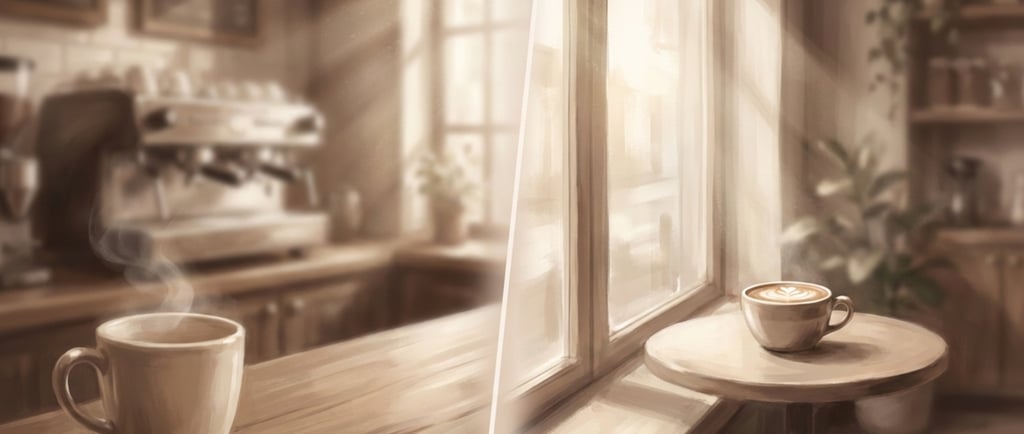
It’s the way she holds the cup. Both hands, like she’s warming them. It’s the way she always sits at the same table if it’s free, the one by the window that catches the afternoon light and makes everything look gentler than it is. It’s the way she sometimes opens a book but doesn’t always read it. Like she brought it to have something to do, but what she really came for wasn’t the pages.
I tell myself not to stare.
I tell myself not to hope.
And then, because my brain is a traitor that knows what it wants, I find myself looking for tiny changes. A different coat. A new ring. A bruise on her knuckle like she punched something or fell or simply walked into a door in an unlucky way. A faint shadow under her eyes.
I know the cadence of her presence so well that when she shifts even slightly, my nerves light up like someone’s pressed a button.
Once, she came in at 3:07.
I watched the clock and tried to act normal, but my entire body had already gone into alert mode, like she’d vanished and returned from another dimension.
“Sorry,” she said when she reached the counter, breathless, hair slightly windblown. “Traffic.”
As if she owed me an explanation.
As if I was someone who had been waiting.
I forced a laugh that sounded like I’d practiced it.
“No worries,” I said, far too quickly. “It’s been a weird day.”
She leaned her elbows on the counter while she paid, and for a second I got that scent again. Something clean and warm. Like soap and sun.
“Has it?” she asked.
I made a non-committal noise, and she tilted her head, considering me.
In another universe, maybe I would have said, It was fine until you were late and then it felt like someone held my lungs under water.
Instead I said, “Just busy.”
“Busy is… good,” she offered, like she was trying to convince herself as much as me.
I nodded, and she took her drink and went to her table, and my hands shook so badly I had to press my palms flat to the counter until the tremor faded.
It startled me, how easy she made it to feel like this. Like my heart was something with a physical edge, something that could cut.
It startled me even more that she kept coming back.
Tuesdays and Thursdays.
Three o’clock.
For a while, I convinced myself it was because we were close to her work. Or because she liked our beans. Or because our oat milk brand was better than the others. Or because she liked the table by the window.
Anything except the truth my mind kept leaning toward like a tongue on a sore tooth.
Maybe she likes me.
Maybe she comes in at exactly 3:00 pm because she wants to see the person who makes her coffee.
But if I let myself believe that, then I’d have to confront the next question.
What do I do with it?
I’ve never been good at first moves. At risk. At the kind of bravery that changes your life. I’ve had crushes, sure. Glances held too long. Fingers brushing by accident and then deliberately avoided afterward, as if touch is contagious.
But this… this felt like something that could become real. And real things have consequences.
I learned early that it’s safer to admire from a distance. To keep feelings like ornaments behind glass. Pretty, but untouchable.
So I stayed behind the counter. I stayed behind the apron. I stayed behind the small lie that everything I did was just part of the job.
Except some days, she made it hard.
Some days, she would look at me in a way that didn’t feel like politeness. A long look, almost questioning. Like she was trying to decide something. Like she was waiting for permission.
And every time, my reflex was the same.
I looked away first.
Not because I didn’t want it.
Because I wanted it too much.
The week before everything changed, she said something new.
It was Thursday. I remember because it was raining, a fine mist that made the whole street look like it had been wrapped in gauze. The café was quieter than usual. The kind of quiet that makes you listen too closely to your own thoughts.
She stepped up to the counter at 3:00 on the dot, shoulders damp, hair darker at the ends.
“Oat latte,” she said, “extra hot.”
I started the motion automatically, hands moving while my brain catalogued her. New scarf, dark green. A tiny freckle near her jawline I’d never noticed before.
Then she hesitated.
“Actually,” she added, voice softer, “can I ask you something?”
My fingers froze on the cup.
“Sure,” I said, and my voice came out thinner than I meant.
She looked down at the counter, then back up, as if gathering courage.
“Do you… do you always make it like this?”
My heart lurched.
I kept my face neutral with the kind of effort that feels like holding a door shut against wind.
“Like what?” I asked, playing stupid, because playing stupid is safer than admitting I understand.
She gave a small laugh, breathy and embarrassed.
“I don’t know. It just… tastes different here. Better.” She cleared her throat. “Sorry. That sounded like I’m complaining. I’m not. I just… I look forward to it.”
I swallowed.
Look forward to it.
Not, I look forward to coffee. Not, I look forward to caffeine.
It.
I wanted to ask what she meant. I wanted to say, Me too, in a way that would crack open the whole careful world I’d built.
Instead I shrugged lightly and said, “We use good beans.”
She smiled, but it didn’t reach her eyes.
“Right,” she said, like she’d expected that answer. Like she’d rehearsed for it.
I forced myself to keep moving. Pulled the espresso. Steamed the oat milk. Added the extra shot with a calm hand, even though my pulse was banging like a fist.
When I handed her the cup, our fingers brushed, brief and electric.
She held the cup for a second longer than necessary, as if she didn’t want to let go.
“Thank you,” she said.
“Anytime,” I replied, and hated how small it sounded.
She walked to her table by the window and sat down, shoulders slightly hunched, like she was keeping herself contained.
I watched her for a moment too long, and when she glanced up and caught me, I turned away, busying myself with wiping a counter that didn’t need wiping.
I told myself I’d messed it up.
I told myself she’d stop coming soon.
I told myself that was for the best.
On Tuesday, I arrived at work ten minutes early. I didn’t admit to myself why. I made a coffee for myself I didn’t need, just to have something to do with my hands.
At 2:58, I wiped the counter.
At 2:59, I checked the milk stock.
At 3:00, the bell didn’t ring.
At 3:01, someone came in and ordered a cappuccino, and I made it with the steadiness of a person trying not to look at the door.
At 3:03, I told myself she’d been delayed.
At 3:06, I felt the tightness begin in my chest, a quiet squeeze that didn’t hurt exactly, but made breathing feel like an effort.
At 3:10, I looked at the door so often I started to feel ridiculous. Like a dog waiting for a car.
She didn’t come.
By 3:30, the part of me that likes proof had enough numbers to confirm what the rest of me didn’t want to accept.
She wasn’t coming today.
I tried to laugh it off internally.
She has a life. A job. She’s busy. It’s raining. She’s probably just… doing something else.
It should have been easy to shrug it off.
Except my body didn’t.
I felt wrong all afternoon. Like a song had skipped and now everything was slightly out of time. I kept expecting the bell. I kept seeing her in the corner of my vision, a phantom of a green scarf, a shoulder turning toward the counter.
At closing, I wiped down the espresso machine with more force than necessary.
My coworker, Sam, watched me with mild concern.
“You okay?” she asked.
“Yeah,” I lied. “Just tired.”
She nodded like she believed me, because most people do. I’m good at being fine. I’ve spent years practicing.
That night, I lay in bed and replayed Thursday’s conversation, the way her eyes had looked when I gave my stupid answer. The way her smile had faltered.
Do you always make it like this?
I look forward to it.
Had she been trying to say something? Had she been testing the water and I’d frozen the lake?
I told myself not to spiral.
It’s just coffee.
It’s just a customer.
And yet, the thought of her not coming back pressed on my ribs like weight.
Thursday arrived too quickly.
I walked to work under a sky that couldn’t decide what it wanted. The morning threatened rain but never delivered. The air had that charged quality, like it was holding its breath.
All day, I tried not to think about 3:00 pm.
At 2:45, my stomach knotted anyway.
At 2:50, I started cleaning things that didn’t need cleaning.
At 2:55, my hands began to sweat.
At 2:59, I stared at the clock until the numbers blurred.
At 3:00, the bell didn’t ring.
My breath caught, involuntarily.
At 3:02, someone walked in, a man in a suit. Not her.
At 3:05, two teenagers. Not her.
At 3:10, an older woman with a stroller. Not her.
I kept my face neutral. I took orders. I steamed milk. I made coffees that tasted fine and meant nothing.
Inside, something in me wilted.
Because this was the moment when it stopped being a one-off.
This was the moment where my routine, the only one that felt like it belonged to me, began to unravel.
At 3:20, Sam leaned in close while I was rinsing a jug.
“You’ve been staring at the door,” she murmured.
I looked at her too quickly.
“No I haven’t.”
She lifted an eyebrow, unimpressed.
“Okay,” she said, drawing the word out. “Just… checking. You seem tense.”
“I’m fine,” I said, and hated that the words had sharpness in them. Like my fear had teeth.
Sam didn’t push. She never does. She just patted my shoulder lightly and went back to the register.
I kept working, but the café felt different now. Too bright. Too loud. Too public. Like all my secret devotion was suddenly stupid under fluorescent lights.
At 4:00, I made an oat latte for someone else and had to physically stop myself from adding the extra shot.
My hand hovered over the portafilter for a second too long.
Then I scraped the excess grounds away and tamped like normal.
The gesture felt like swallowing something you didn’t want to taste.
When my shift ended, I didn’t feel relief. I felt hollow.
Outside, the air was cooler, the sky bruised with evening. I stood on the sidewalk for a moment, apron tied too tight around my waist, and let myself do the thing I hadn’t allowed all week.
I admitted it.
I missed her.
Not just her as a customer. Not just the routine. Her. The woman with the careful steps and the soft please and the eyes that looked like she was always thinking something she wasn’t saying.
I walked home slowly, trying to convince myself it didn’t matter.
People come and go.
Cafés are temporary places.
And I am not, historically, the thing people return to.
That night, I dreamed of the bell over the door ringing endlessly, like an alarm I couldn’t switch off.
On Tuesday, I didn’t arrive early.
I told myself that was progress.
I told myself I was reclaiming my brain.
I told myself I was letting it go.
At 3:00 pm, I didn’t look at the clock.
At 3:01, I did anyway.
At 3:05, I pretended I hadn’t.
At 3:10, my stomach dropped again, familiar now, like my body had decided this was the new ritual.
She didn’t come.
The café filled with late-afternoon customers. Voices layered over each other. Coffee orders and laughter and chairs scraping on the floor. The world kept moving, unconcerned.
My chest felt tight, but I could still work. I could still smile. I could still say, “No worries,” and “Have a great day,” and mean it to strangers.
But every time the bell rang, some part of me braced for disappointment.
At 4:15, someone stepped up to the counter and my heart jumped before my eyes even registered her.
It wasn’t her.
It was a woman with red lipstick and sharp cheekbones. She ordered a flat white and left without lingering.
I made it perfectly and felt nothing.
When I got home that night, I stood in my kitchen and stared at my phone like it might contain an answer.
I didn’t have her number.
I didn’t know her name.
All I had was the shape of her presence and the quiet space she’d left behind.
I started to feel foolish. Not just sad, but embarrassed. As if the universe itself might be watching and rolling its eyes.
Look at her. Falling apart over a customer.
Over a coffee.
Over a fantasy she built out of an extra shot and a smile.
On Thursday, I woke up with a kind of resignation in my bones. Like my body had finally accepted what my mind had been trying to force.
She’s not coming back.
I went to work. I tied my apron. I pulled shots. I steamed milk. I did everything like normal.
At 2:58, I didn’t clean.
At 2:59, I didn’t hover.
At 3:00, the bell rang, and I didn’t even look up.
At 3:01, Sam said softly, “Hey.”
Something in her tone made my head lift anyway.
And there she was.
In the doorway, half-lit by the afternoon sun, like she’d stepped out of a memory and into the wrong week.
For a second, I didn’t breathe.
She looked different.
Not dramatically. Not in a way anyone else would notice. But my brain caught it instantly, the way it always did. Her hair was pulled back. Her cheeks were slightly flushed. Her shoulders were tense, like she’d been carrying something heavy.
And her eyes.
Her eyes found mine immediately, like she’d been looking for them.
My hands went cold.
She stepped inside, and the bell’s chime sounded louder than it ever had.
She came to the counter, and I felt the café shrink around us. The noise dulled. The space narrowed.
Her lips parted, and for once, she didn’t start with the order.
“Hi,” she said.
I managed, “Hi.”
It was pathetic, the simplicity of it. Like we were strangers meeting for the first time, instead of two people who had been orbiting each other for months.
She swallowed. Her gaze flicked down to the counter, then back up.
“I’m sorry,” she said, and the words were immediate, urgent. “I didn’t mean to… disappear.”
My heart stuttered.
I kept my face neutral out of pure survival instinct. Like if I let anything show, it would all spill out at once.
“It’s… okay,” I said.
It wasn’t.
But it was also the only thing I could say.
She nodded, but her brows pinched together, like that answer hurt.
“I had to go out of town,” she said, like she needed me to understand. “Family stuff. It was… sudden.”
“Oh,” I whispered. “I hope everything’s alright.”
She looked at me, and something softened in her expression.
“It is now,” she said, and the way she said it landed somewhere low in my chest.
Then she took a breath, steadying herself.
“I kept thinking about… this place,” she added. “About coming back.”
My mouth went dry.
I should have responded with something safe, something professional.
We’re always here. Same hours. See you next time.
Instead I heard myself say, quieter, “I noticed.”
Her eyes widened.
“You did,” she repeated, and it wasn’t a question. It was disbelief. Almost wonder.
I regretted it instantly. The admission sat between us like an exposed wire.
I tried to pull it back, to cover it with something casual.
“I mean,” I rushed, “it’s… you come in regularly. Tuesdays and Thursdays. It’s—”
“I know,” she interrupted, a small smile flickering. “I know I do.”
She hesitated.
Then she said it, so softly it could have been swallowed by the espresso machine, if the café had been any louder.
“I come in because of you.”
My entire body went still.
The world didn’t tilt dramatically. There was no cinematic swell. Just… quiet. Like everything in me had paused to make room for those words.
My brain tried to reject them.
No. She doesn’t mean that. She means the coffee. The service. The vibe. The location.
But she was looking at me in a way that made it impossible to pretend.
Direct. Nervous. Honest.
Like she’d stepped out of a safe script and into something real.
“I…” I started, and nothing came.
Her shoulders rose with a breath.
“Sorry,” she said quickly, cheeks flushing darker. “That sounded… too much. I just meant, I like… seeing you. Talking to you. Even if it’s just—”
“Coffee,” I finished automatically.
She gave a faint laugh, eyes crinkling.
“Yeah.”
My hands were shaking. I gripped the edge of the counter under the bar so she wouldn’t see.
I wanted to say something that didn’t make me sound like a frightened animal. Something smooth.
Instead the truth slipped out, small and unpolished.
“I thought I’d scared you off.”
Her mouth fell open slightly.
“What?” she whispered.
My heart pounded. I could feel it in my throat, like it wanted to climb out.
“Last time you were here,” I said, forcing myself to keep going before I chickened out, “you asked if I always make it like that. And I… I gave you a stupid answer.”
She blinked, then shook her head.
“It wasn’t stupid.”
“It was,” I said, and my voice trembled. “Because I wanted to say something else.”
Her gaze locked on mine.
“What did you want to say?”
The café around us kept moving. Someone laughed. A blender whirred. Sam called out an order. The world carried on as if we weren’t standing here with our lives splitting into a before and after.
I swallowed.
And for once, I didn’t look away first.
“I wanted to say,” I began, and my voice came out quiet but steady, “that I look forward to it too.”
Her eyes filled with something that made my chest ache.
“Oh,” she breathed, like the word held relief.
Then, after a beat, she smiled properly. Teeth this time. Bright and stunned, like she’d just been handed something she didn’t think she was allowed to want.
“I… I do,” she admitted. “I look forward to it all week.”
A laugh escaped me, shaky and disbelieving.
“That’s…” I said, and couldn’t finish the sentence.
She glanced down, then back up, gathering herself again.
“And,” she added, voice dropping slightly, “the thing is… I always thought you were just being nice. Like you had to be.”
I felt my lips part in surprise.
“I mean, you are,” she said quickly. “You’re nice to everyone. But with me it felt… different. And then I told myself I was imagining it.”
My stomach flipped.
Because that was my story too. The same script, different actor.
My voice came out smaller than I intended. “You weren’t imagining it.”
Her gaze flicked to my hands on the counter. Then up again.
“Can I ask you something?” she said.
My pulse jumped. “Okay.”
She inhaled, held it, released it slowly.
“Is the extra shot… on purpose?”
For a moment, all I could do was stare at her.
My cheeks burned.
My throat tightened.
I should have denied it. I could have. I could have smiled and said, “Just how the machine pulls it sometimes,” and we could have stayed safe, kept the devotion hidden behind plausible deniability.
But she was here.
She had said she came in because of me.
And something in me, some small stubborn part that was tired of being background, stepped forward.
“Yes,” I said.
Her eyes widened again, and then she laughed, a quiet, delighted sound.
“Oh my god.”
I felt myself smile, helpless.
“I didn’t want to make it weird,” I blurted, mortified. “I just… I noticed you liked it that way and then it became a thing and then I couldn’t stop and—”
She reached out before she seemed to realise she was doing it, her fingers touching the back of my hand on the counter.
The contact was light. Careful.
But it grounded me like nothing else.
“It’s not weird,” she said. “It’s… sweet.”
My brain short-circuited on the word sweet, as if it was a description I didn’t know I could earn.
I stared at her fingers on my skin like I might disappear if I moved.
She pulled her hand back slowly, as if giving me space to breathe again.
“I’m sorry I disappeared,” she said again, softer now. “I didn’t mean to make you think I’d just… stopped.”
I tried to swallow, failed.
“I didn’t have the right to… care,” I admitted, and the honesty surprised me as much as it did her.
Her expression shifted, tender and earnest.
“Maybe you did,” she said.
There was a pause, the kind that holds a choice inside it.
Then she lifted her chin slightly.
“Would it be… completely unhinged,” she asked, “if I asked you to sit with me for five minutes?”
My heart jolted.
“I’m working,” I said automatically, because my reflexes are ancient.
“I know,” she said quickly, almost wincing. “Sorry. That was stupid.”
“It wasn’t stupid,” I said, before I could stop myself.
She looked at me, hopeful and nervous.
I glanced toward Sam, who was wiping the pastry case with exaggerated focus, very clearly pretending she couldn’t hear anything while also absolutely hearing everything.
Our eyes met.
Sam lifted her eyebrows and made a tiny shooing gesture, like she was waving away a fly.
Go.
My mouth fell open.
Sam mouthed, “I’ve got it.”
My chest loosened in disbelief.
I looked back at the woman in front of me.
Her hands were wrapped around her cup like she was anchoring herself. She looked like someone who had decided to be brave and was terrified she’d made a mistake.
I untied my apron with fingers that didn’t quite work.
“Five minutes,” I said, voice soft. “Yeah.”
The smile that spread across her face made my stomach flip again, but this time it wasn’t dread.
It was something warmer.
I stepped out from behind the counter, feeling strangely exposed without the barrier between us. Like I’d been behind glass and now I was in open air.
She picked up her latte and walked to the window table, glancing back at me as if she couldn’t believe I was following.
I sat opposite her, hands in my lap, posture too stiff because I didn’t know what to do with myself outside the role I’d practiced.
Up close, I could see the little details: the faint line near her brow where she frowned when she was thinking. The tiny nick on her thumbnail. The softness at the corners of her mouth, like laughter lived there often.
She took a sip of her latte and closed her eyes briefly, like it was a ritual.
When she opened them again, she was smiling.
“Still perfect,” she said.
Heat crawled up my neck. “Good.”
There was a pause.
She looked down at her cup, then back up.
“I’m Mara,” she said, like she was offering me something precious.
I felt my breath catch.
“Mara,” I repeated, tasting it.
She smiled. “Yeah.”
I swallowed. “I’m… I’m Elise.”
“Elise,” she said, and her voice softened around my name in a way that made my ribs ache.
It was such a small thing, names. Two syllables each. But it felt like a door opening.
Mara tilted her head slightly, studying me.
“You really thought you scared me off?” she asked.
I stared at the table for a second, embarrassed.
“I thought… I don’t know. Maybe you realised you were coming in too often. Maybe you’d decided it meant nothing.”
Mara’s gaze stayed on me, gentle but unwavering.
“I realised it meant too much,” she said quietly. “And then my mum called and everything went sideways and I had to leave. But I kept thinking about you the whole time.”
My throat tightened again.
“You did?” I whispered.
She nodded, and the seriousness in her face made it impossible to pretend she was joking.
“Yes,” she said. “And I kept thinking… if I come back and you act like you don’t know me, I’m going to feel stupid. And if you act like you do know me, I’m going to feel… worse, because then I’ll have to decide what I’m doing about it.”
My pulse thudded.
“And what are you doing about it?” I asked before I could stop myself.
Mara’s lips parted. She seemed startled by my directness, then something like relief crossed her face.
“I’m trying,” she said, voice quiet, “to stop treating my feelings like a private embarrassment.”
The words hit me like a bell.
Because that was exactly what I’d been doing.
Mara smiled, small and sincere.
“And,” she added, glancing at my hands, “I’m trying to figure out if you’d ever want to see me… when you’re not being paid to.”
My entire body went warm and weightless at once.
I stared at her, my brain scrambling for something safe, something controlled.
But the truth rose up, plain and uncomplicated.
“Yes,” I said.
Mara blinked.
“Yeah?” she asked, like she didn’t trust the ease of it.
I nodded. “Yeah.”
A breath left her like she’d been holding it for weeks.
Then she laughed, soft and disbelieving.
“Oh,” she said, and her cheeks flushed again. “Okay. Good. Because I was… very close to walking out of here and never coming back.”
My stomach dropped at the thought.
“Don’t,” I said, the word sharper than I intended.
Mara’s eyes softened.
“I won’t,” she promised. “Not if you don’t want me to.”
I tried to smile, but it came out fragile.
“I don’t want you to,” I admitted.
The café light through the window caught her face and made her look impossibly warm, like the world was leaning in.
Mara lifted her cup slightly.
“So,” she said, voice playful now, relief threading through it, “does this mean I get to know your name and still get the extra shot?”
I laughed, the sound surprising me with its steadiness.
“It does,” I said.
“And,” she added, eyes bright, “maybe I can stop pretending I don’t schedule my week around coffee.”
My cheeks warmed. “You do?”
Mara tilted her head.
“Elise,” she said gently, “I rearranged a meeting today so I could be here at three. I told my coworker it was… important.”
My chest squeezed, but this time the ache was sweet.
“And was it?” I asked.
Mara looked at me like the answer was obvious.
“Yes,” she said. “It was.”
We sat there for a moment, the noise of the café washing around us. A life continuing. A world unaware.
But inside that small square of sunlight at the window table, something had shifted.
Not dramatically.
Not loudly.
Just enough that my routine didn’t feel like a private ache anymore.
It felt like the beginning of something.
Mara glanced toward the counter, where Sam was very deliberately not looking at us.
“You probably have to go back,” she said reluctantly.
I swallowed. “Yeah. I do.”
Mara’s fingers brushed the edge of her cup, hesitant.
“Can I… give you my number?” she asked.
My heart kicked.
“Yes,” I said too quickly, and then, softer, “Yes, please.”
Mara smiled, pulled out her phone, and slid it across the table.
I typed my number in with hands that still shook, but now the shaking felt like excitement instead of fear.
When I passed the phone back, her fingers grazed mine again. This time, she didn’t pull away as fast.
“I’ll text you,” she said.
I nodded. “Okay.”
“And,” she added, eyes flicking up, “if you’re free after your shift… maybe we could… go somewhere that doesn’t smell like espresso.”
I laughed. “I’d like that.”
Mara stood, picked up her latte, then hesitated.
“Same time Thursday?” she asked, voice light but eyes serious.
My throat tightened.
“Thursday,” I echoed. “Three.”
She smiled.
And before she walked away, she leaned in slightly and said, so quietly only I could hear it over the hum of the café:
“I’m really glad you noticed.”
Then she turned and left, the bell chiming behind her, bright and clear.
I sat for another second, stunned, my heart thumping hard enough to make my fingertips tingle.
When I finally stood and went back behind the counter, Sam was waiting with a grin so wide it was almost rude.
“Five minutes,” I warned her, trying to sound stern.
Sam held up her hands. “No judgment. Only celebration.”
I rolled my eyes, but I couldn’t stop the smile tugging at my mouth.
As I tied my apron again, I caught my reflection in the espresso machine’s chrome, blurred and warped, but still unmistakably me.
And for once, I didn’t look invisible.
Not to her.
Not anymore.
At 3:07 pm, my phone buzzed in my pocket.
I didn’t check it right away. I made myself finish the latte I was steaming, pour it carefully, hand it across the counter with a polite smile.
Then, with my heart in my throat, I pulled my phone out and glanced down.
A message from an unknown number.
Mara: Hi Elise. Just making sure this is real and I didn’t hallucinate you coming to sit with me ☕🙂
I stared at the screen, a laugh bubbling up, warm and helpless.
Then I typed back.
Real. And you didn’t hallucinate the extra shot either.
I paused, then added:
See you after my shift?
Three dots appeared almost instantly.
Mara: Yes. And Elise?
I swallowed.
Mara: I look forward to it.
I held the phone close for a second, like it was something fragile and miraculous.
Outside, the afternoon moved on. Cars passed. People hurried by. The sky softened toward evening.
Inside, the café smelled like coffee and possibility.
And for the first time, Tuesdays and Thursdays weren’t just routine.
They were ours.
Every love story has two truths.
This was Elise’s.
If you want Mara’s side, you can unlock it by joining the newsletter. Subscribers get access to a private library of “Two Sides of the Same Story” pairings (plus the newsletter vault).
👉 Join here to read the other side.
Or, if you’d like the complete pair as a polished keepsake:
👉 Collector Edition on Etsy (both stories + bonus epilogue).
Contact
Questions or thoughts? Reach out anytime.
© 2025. All rights reserved.