The Library Chair
She keeps choosing the chair that squeaks just so the other woman will glance up and smile every time it betrays her.
SHORT STORYROMANCE
3/4/202614 min read
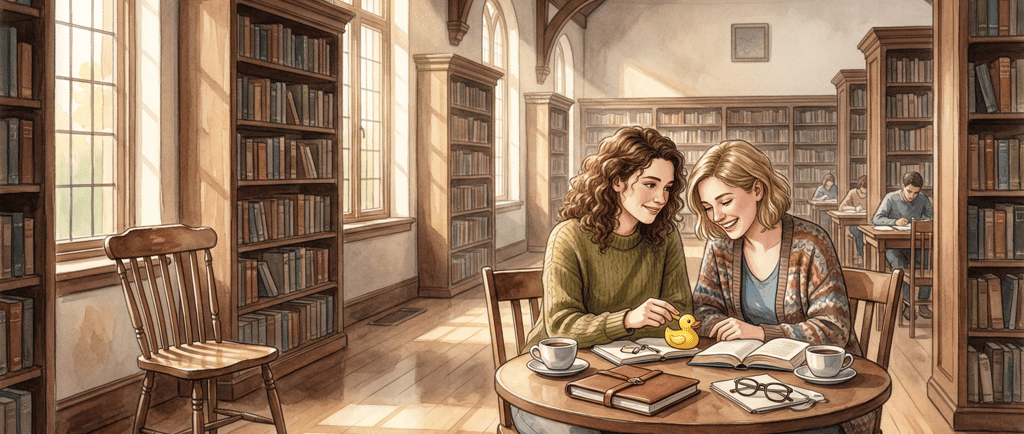

The first time it happened, it was an accident.
Or, at least, that’s what Belinda told herself as she lowered into the high-backed chair by the library’s big window and it responded with a noise that could only be described as an elderly trombone attempting jazz.
Squee-ERRK.
Three heads popped up across the reading room. A teenager in headphones blinked like she’d been unplugged. A man in a cardigan scowled over the top of his book as if Belinda had personally offended literature.
And then, at the far table near the biography shelves, a woman glanced up, met Belinda’s eyes for half a second…and smiled. Not polite. Not pitying. The kind of smile that suggested she’d just watched a tiny, harmless crime and approved of it.
Belinda felt her cheeks warm. She did the only dignified thing possible after being betrayed by furniture.
She froze halfway down, hovering in a half-squat like a very committed museum statue.
The chair, apparently delighted by her hesitation, offered a second, smaller squeak.
Squee.
The smiling woman bit her lip, a laugh held carefully behind her teeth, and then went back to her book as if nothing had happened.
Belinda sat. The chair made one last victorious note, like a curtain call.
It wasn’t her usual seat. Belinda had a usual seat. She was a creature of habit in the way that made librarians and cats trust you instinctively. Normally, she chose the chair in the corner near the travel section: soft, quiet, and nonjudgmental.
But that chair had been taken by an older man who looked like he’d been born reading.
So Belinda had chosen the window chair.
The squeaky chair.
The chair that had just introduced her, loudly, to the entire library.
The woman at the biography table—hazel-eyed, dark hair pinned messily at the back of her neck—lifted her gaze again as Belinda pulled out her notebook and tried to look like someone who had squeaky-chair confidence on purpose.
The woman’s smile returned briefly, a flicker like a match struck.
Belinda looked down so quickly she nearly headbutted her own pen.
She stayed for two hours. Worked on nothing. Wrote down three grocery items and the word “squeak” six times, as if studying it might make it less humiliating.
When she finally left, the chair gave a farewell squeal that felt personal.
Squee-ERRK.
The woman looked up again and raised her eyebrows as if to say, Bold exit.
Belinda walked out of the library with the distinct feeling she had been quietly adopted by an attractive stranger and a problematic piece of furniture.
The second time it happened, it was a decision.
Belinda stood in the entrance and made a slow, careful survey of the reading room like a woman casing a bank. She wasn’t looking for money. She was looking for:
The squeaky chair.
The woman who had smiled at her.
A plausible reason for why her feet were already walking toward the window.
The chair was empty, angled slightly toward the light, as if waiting. Belinda had the absurd thought that it looked smug.
The woman was there too, at the same table, same section, same elegant slump of someone who could read for hours without noticing time. Today she wore a soft grey sweater and had a pencil tucked behind one ear like she’d been born ready to underline something important.
Belinda’s stomach performed a small gymnastics routine.
She walked to the squeaky chair and sat with exaggerated care, like a person defusing a bomb. For a moment, nothing happened.
Belinda allowed herself a breath.
Then the chair, as if offended by her restraint, let out a long, drawn-out complaint.
Squeeeee-ERRK.
The woman looked up instantly, like it was a cue in a play. This time she didn’t hide the laugh, just let it curve her mouth.
Belinda cleared her throat and tried to appear as if she lived a life full of dramatic chair sound effects.
She opened her notebook. Wrote:
Purchase new chair. Burn this one. Apologise to everyone.
Across the room, the woman stood, slid a bookmark into her book, and walked over.
Belinda’s brain provided several helpful options:
Pretend to be asleep.
Pretend to be dead.
Pretend to be someone else entirely, perhaps a potted plant.
Instead, she stayed upright, which felt like bravery even though she was fairly sure her insides were now soup.
The woman stopped beside the chair and looked down at it with deep suspicion.
“That chair,” she said quietly, “has a vendetta.”
Belinda stared. A voice came out of her mouth, which surprised her.
“It hates me.”
“I don’t think it hates you,” the woman said, and her eyes flicked to Belinda’s face for a beat longer than necessary. “I think it’s…performative.”
Belinda snorted before she could stop herself.
That made the woman smile again, and it was even better up close, the kind of smile that made you want to become a person who said witty things in libraries for a living.
“I’m Amanda,” she added, and held out her hand as if they were meeting at a normal time and not during Belinda’s ongoing humiliation.
“Belinda,” Belinda said, shaking it. Amanda’s hand was warm. Belinda’s brain filed the sensation away under: threateningly pleasant.
Amanda’s gaze dropped to Belinda’s notebook, where Belinda had scribbled “burn this one” beneath a small, angry chair doodle.
Amanda’s eyebrows rose. “Dramatic.”
“The chair started it,” Belinda said.
“I’ve been watching it start things for weeks,” Amanda replied, completely unapologetic about the fact that she had been watching Belinda.
Belinda’s face heated. “You have?”
Amanda nodded toward the chair. “You always look like you’re trying to negotiate with it.”
“I’m trying to survive it.”
“That’s fair.” Amanda leaned slightly closer, lowering her voice like a co-conspirator. “If you ever want to defeat it, I’ve developed a strategy.”
Belinda’s heart did something unhelpful.
“What strategy?”
Amanda pointed at the chair’s front legs. “You put your foot there when you sit. Stabilises it. Minimises the squeak.”
Belinda blinked. “Why do you know that?”
Amanda’s eyes glinted. “Because it squeaks for everyone. It squeaks for me too.”
Belinda looked at Amanda’s table. “Then why don’t you sit there?”
Amanda’s smile softened, and for a second she seemed oddly shy. “Because I…kind of like when it squeaks.”
Belinda’s brain stopped entirely, like a laptop that had encountered a situation outside its operating system.
Amanda tapped the top of Belinda’s chair lightly, as if patting an unruly pet. “Anyway. I just wanted to introduce myself and make sure you knew you weren’t alone in this war.”
Then she turned and walked back to her table with her book tucked under her arm, as if she hadn’t just dropped a sentence into Belinda’s life that sounded suspiciously like an excuse to keep looking up.
Belinda sat very carefully again, her foot bracing the chair leg like Amanda had shown.
The chair made a smaller, disgruntled squeak.
Squee.
From across the room, Amanda glanced up and smiled.
Belinda wrote in her notebook:
Chair is now an accomplice. Unclear if I hate that.
A week later, Belinda realised she was planning her library visits around Amanda.
This was a ridiculous thing to do. Belinda was thirty-two years old. She paid bills. She owned two different kinds of tea and a small plant she had managed to keep alive for almost a year, which felt like proof of competence.
And yet, on Wednesday morning, she woke up and thought, If I go at eleven, she’ll probably be there.
Then she thought, Stop being creepy.
Then she thought, But what if she is there and I miss her?
Then she thought, How did a chair do this to me?
When she arrived, the squeaky chair was taken.
Not by Amanda. By a middle-aged woman wearing a floral scarf, who sat in it without fear or caution. The chair stayed silent.
Belinda stood at the entrance, offended.
So it squeaks for me but not for her? Is this chair ageist? Is it discriminating against…new people?
She scanned the room for Amanda.
Amanda wasn’t there.
Belinda’s brain did that thing where it tried to pretend she was fine while her chest felt like someone had removed one small, essential part and left a hollow space.
She chose a different chair. A quiet one. A sensible one. A chair that didn’t expose her to public embarrassment or romantic possibility.
It was deeply unsatisfying.
She opened her notebook. Tried to work.
Every now and then, her eyes flicked toward the door.
After twenty minutes, she saw Amanda walk in carrying a coffee and a canvas tote bag that said SUPPORT YOUR LOCAL LIBRARY in bold letters. Amanda paused as she took in the room, her gaze sweeping like she was looking for something.
When she spotted Belinda in the quiet chair, Amanda’s expression shifted subtly. Like she was pleased. Like she’d found her landmark.
Amanda walked over, coffee in hand, and set it down on Belinda’s table.
Belinda looked at it. “Is this…for me?”
Amanda nodded. “You weren’t in the squeaky chair.”
Belinda huffed. “It was occupied.”
Amanda glanced toward the floral-scarf woman. “Traitor.”
Belinda laughed, then immediately tried to soften it into something more dignified. It did not work.
Amanda slid into the chair opposite her, close enough that Belinda could smell coffee and something clean and citrusy.
“I think it’s jealous,” Amanda said, as if continuing an ongoing discussion with the chair itself.
Belinda stared at her. “Are you saying the chair…”
“Has feelings?” Amanda shrugged. “Sure.”
Belinda’s mouth quirked. “And it has a vendetta. And it’s performative.”
“Obviously.”
Belinda gestured at the coffee. “And this is…a bribe?”
“A peace offering,” Amanda corrected. “I also brought snacks.”
From her tote bag, Amanda produced a small packet of biscuits and slid them onto the table like a dealer offering contraband.
Belinda lowered her voice, playing along. “You know food isn’t allowed in the reading room.”
Amanda’s eyes sparkled. “We’re not eating. We’re…holding them.”
Belinda leaned closer, a conspiratorial grin tugging at her mouth. “You’re a menace.”
Amanda lifted her coffee cup in salute. “And you’re the kind of person who draws angry chairs in her notebook.”
Belinda covered the edge of her notebook instinctively.
Amanda smiled like she’d caught a secret. “It’s cute.”
Belinda’s cheeks warmed. “It’s…unfortunate.”
“It’s you,” Amanda said simply.
Something in Belinda went quiet and attentive, like a page being turned.
They sat like that for a while, not talking much. Just reading, writing, occasionally exchanging a look when someone dropped a book too loudly or the printer jammed at the front desk again.
At one point, Amanda wrote something on a sticky note and slid it across the table.
Belinda peeled it up and read:
If you want to claim the squeaky chair later, I’ll help you overthrow the floral-scarf lady.
Belinda fought a smile. Wrote back on another sticky note:
Does your coup involve snacks?
Amanda’s response was immediate:
All successful revolutions do.
Belinda looked up and met Amanda’s eyes.
Amanda smiled, slow and warm, like she had nowhere else to be.
Belinda realised, with the sharp clarity of a bell, that she wanted Amanda to keep showing up in her life in small ridiculous ways. She wanted coffee on tables and sticky notes and secret snack crime. She wanted the comfort of someone who understood her humour.
She wanted the person.
And, apparently, she wanted the chair.
Two weeks after that, Belinda arrived to find a small sign taped to the squeaky chair.
OUT OF ORDER. DO NOT SIT.
Belinda stared, devastated, like she’d just been informed an old enemy had died before she could properly defeat it.
She looked around for Amanda.
Amanda was already there, standing beside the chair with her hands on her hips, frowning at the sign like it had personally insulted her.
“They finally did it,” Amanda said as Belinda approached.
“What do you mean, ‘finally’?”
Amanda turned. “They’ve been threatening to retire it for ages. It’s the loudest chair in the building. It’s basically a siren.”
Belinda stared at the chair. It looked exactly the same. Innocent. Unrepentant.
“It can’t be out of order,” Belinda said, absurdly. “It squeaks. That’s its…function.”
Amanda’s lips twitched. “Tell that to Management.”
Belinda leaned closer to inspect the sign, as if she could argue it into existence. “What happened?”
Amanda’s expression went smug. “Apparently, someone complained it was ‘disruptive.’”
Belinda’s mouth fell open. “Who would complain about that?”
Amanda pointed, subtly, with her chin.
The cardigan man from Belinda’s first day sat at his table, reading like a man who would sue a cloud for being too loud.
Belinda’s eyes narrowed. “He did this.”
Amanda nodded. “He did this.”
Belinda’s grief shifted quickly into righteous indignation, which, in her experience, was the most useful emotion for action.
“We can’t allow it,” Belinda whispered.
Amanda’s eyes gleamed. “I was hoping you’d say that.”
Belinda blinked. “You have a plan?”
Amanda reached into her tote bag and pulled out a small toolkit.
Belinda stared at it. “Amanda.”
“What?” Amanda looked perfectly innocent. “I own things.”
Belinda pointed at the toolkit. “Why do you own that?”
Amanda’s smile turned sheepish. “I fix things.”
“Are you going to fix the chair?”
Amanda glanced at the sign like it was a personal challenge. “I’m going to liberate the chair.”
Belinda took a step back. “In the library.”
“Yes,” Amanda said, as if that answered everything.
Belinda looked around. The front desk librarian, a woman with cat-eye glasses, was stamping returns with a level of focus that suggested she would not tolerate chair-based rebellions.
Belinda lowered her voice. “We’ll get caught.”
Amanda leaned closer, eyes bright. “Not if we do it like professionals.”
Belinda squinted. “Are you a chair professional?”
“I’m an engineer,” Amanda whispered.
Belinda stared at her. “You’re an engineer.”
Amanda nodded. “Mechanical. I work with…much louder, more dramatic equipment than this.”
Belinda’s brain tried to reorder itself. “So this chair squeaks for you too…”
“Mm-hm.”
“And you…like when it squeaks…”
Amanda’s gaze softened. “Mm-hm.”
“And you were watching me…”
Amanda’s smile turned a little shy again. “Mm-hm.”
Belinda’s chest tightened in a way that felt suspiciously like affection.
Amanda lifted the toolkit slightly. “If you want, we can leave it. Respect the sign. Accept that the chair’s time has passed.”
Belinda stared at the chair. The window light fell across it, making it look almost heroic.
“No,” Belinda said, immediately. “We can’t just let it be silenced. That chair brought us together.”
Amanda’s eyes warmed. “It did.”
Belinda drew herself up, as if preparing for battle. “Fine. What do you need me to do?”
Amanda’s grin was pure delight. “Be my lookout.”
Belinda’s heart did something reckless.
They moved like thieves. Amanda knelt at the chair’s legs, her toolkit opened carefully, screws and a tiny wrench laid out like surgical instruments.
Belinda stood beside her, pretending to browse a nearby shelf while monitoring the room with the intensity of someone defusing a bomb with romance attached.
Amanda’s fingers worked quickly and confidently. Every so often, she glanced up at Belinda, smiling like this was the best day she’d had in weeks.
Belinda tried not to melt into the carpet.
The librarian looked up once. Belinda immediately grabbed a random book from the shelf and opened it as if she had been deeply invested in…European Train Routes: 1987 Edition.
The librarian’s gaze lingered.
Belinda forced her face into an expression of sincere scholarly interest.
The librarian looked away.
Belinda whispered, barely moving her lips, “We’re going to die.”
Amanda whispered back, “At least it’ll be romantic.”
Belinda choked on a laugh and had to turn away.
After a few minutes, Amanda tightened the last screw, then sat back on her heels with the satisfied expression of someone who had wrestled machinery into submission.
“Okay,” Amanda murmured. “Try it.”
Belinda stared at the chair. This felt momentous. Like a ceremonial event. Like the chair should be sworn in.
She lowered into it carefully.
Nothing.
Belinda froze.
Amanda’s eyebrows rose. “Well?”
Belinda sat fully.
Still nothing.
The chair, the infamous squeaky chair, sat silent under her like a perfectly normal piece of furniture.
Belinda’s mouth fell open. “You…fixed it.”
Amanda’s face fell slightly. “I did.”
Belinda stared, horrified. “But…what about the squeak?”
Amanda’s eyes widened. “Belinda, you said it was disruptive. You said it betrayed you.”
“It did,” Belinda said desperately. “But it also…”
Amanda waited.
Belinda swallowed. “It also made you look up.”
Amanda’s expression softened.
Belinda looked down at her hands. “It made you smile.”
Amanda’s voice was quiet. “Yes.”
Belinda looked up. “So now what?”
Amanda held Belinda’s gaze for a long beat, the library around them suddenly fading like background noise. “Now,” Amanda said, “I find another way to make you look up.”
Belinda’s breath caught.
Amanda stood and, with a quick glance around, slid into the chair opposite Belinda like they were resuming their usual ritual. She reached into her tote bag again and produced something with theatrical care.
She set it on the table between them.
It was a small hand-held squeaker. The kind you’d give a dog. Bright yellow. Shaped like a duck.
Belinda stared.
Amanda squeezed it.
SQUEEAK.
The sound was unmistakable. Loud enough to make several heads turn.
The cardigan man scowled so hard his eyebrows nearly left his face.
Belinda burst into laughter, sharp and helpless, covering her mouth with her hand.
Amanda smiled like she’d just won something.
Belinda leaned forward, whispering, “You absolute menace.”
Amanda squeezed it again, softer this time. squeak.
Belinda tried to glare, but it kept collapsing into a grin. “We’re going to get banned.”
Amanda’s eyes were warm. “Worth it.”
Belinda’s laughter faded into something gentler. She looked at Amanda’s hands, at the ridiculous duck, at the quiet bravery of someone willing to be silly in a library just to earn a smile.
“You brought that,” Belinda whispered, “to replace the chair.”
“I brought it,” Amanda corrected, “because I wanted an excuse to talk to you.”
Belinda’s heart went tender and messy.
“You could have just…talked to me,” Belinda said.
Amanda’s smile turned soft. “I know. But then I wouldn’t have gotten to watch you wage war with furniture first.”
Belinda groaned and hid her face briefly. When she looked up again, Amanda was watching her like she was something precious and funny and entirely worth the effort.
Belinda leaned forward. “Are you going to keep showing up?”
Amanda’s gaze didn’t flicker away. “If you want me to.”
Belinda’s voice came out quieter. “I do.”
Amanda reached across the table, slow enough that Belinda could pull away if she wanted, and took Belinda’s hand.
Belinda’s fingers curled around hers immediately, like the choice had been made weeks ago.
Amanda squeezed the duck with her other hand.
SQUEEAK.
Belinda laughed again, softer. “You’re unbelievable.”
“I’m committed,” Amanda said. “To the bit.”
Belinda lifted their joined hands slightly. “And to…this?”
Amanda’s thumb brushed over Belinda’s knuckles. “Also this.”
Belinda’s chest warmed in that unmistakable way where life suddenly felt kinder than expected.
She glanced around. The librarian was watching them now, expression unreadable.
Belinda’s shoulders tightened.
The librarian walked over slowly, cat-eye glasses catching the light.
Belinda braced herself for the lecture, the expulsion, the shame of being escorted out by someone who smelled faintly of book glue and authority.
The librarian stopped beside the table, looked at the duck squeaker, then at Amanda, then at Belinda.
She lowered her voice. “If you’re going to commit acts of nonsense in my library,” she said, “you need to commit fully.”
Amanda blinked. “Excuse me?”
The librarian reached into her cardigan pocket and pulled out a roll of tape. She slapped a small label onto the duck squeaker with brisk efficiency.
It read:
EMOTIONAL SUPPORT SQUEAKY DEVICE
Belinda stared.
The librarian leaned in slightly. “Also,” she added, “the chair was not out of order. It was being assessed.”
Belinda’s eyes widened. “So…we didn’t have to…”
The librarian’s mouth twitched in what might have been a smile. “No.”
Amanda’s face went pink. “Oh.”
The librarian straightened. “But I’m glad you did. That chair has been miserable for years. Now it’s quieter and, frankly, less dramatic.”
She glanced at Belinda. “You two, however, appear to be maintaining the library’s required level of drama.”
Belinda tried to speak and failed.
The librarian tapped the duck label once, like stamping it official. “Keep it down. Or at least keep it adorable.”
Then she walked away as if nothing had happened.
Belinda stared after her. “Did we just get…blessed by a librarian?”
Amanda’s smile was dazed. “I think we did.”
Belinda looked back at Amanda, still holding her hand, still grinning like the world had leaned in to tease them gently.
“I feel like,” Belinda said, “we should make this official.”
Amanda’s eyebrows rose. “The duck?”
Belinda laughed. “Us.”
Amanda’s gaze softened, serious beneath the humour. “Okay.”
Belinda’s voice was small but certain. “Okay?”
Amanda nodded. “Okay.”
Belinda felt something settle into place, like a book sliding back into the right spot on the shelf.
Amanda leaned closer across the table. Belinda met her halfway.
Their kiss was warm and sweet and unmistakably real, a gentle press that said, Yes, this is happening. Yes, this is us. Yes, I’m staying.
Somewhere in the distance, the cardigan man made a sound of deep disapproval.
Amanda pulled back slightly and, without breaking eye contact, squeezed the duck.
SQUEEAK.
Belinda laughed into Amanda’s smile.
Amanda whispered, “Now every time you hear that, you have to look up.”
Belinda whispered back, “I already do.”
Amanda’s smile went soft in a way that made Belinda’s chest ache pleasantly.
“Good,” Amanda murmured, thumb stroking Belinda’s hand. “Because I plan on giving you plenty of reasons.”
Belinda leaned in and kissed her again, certain as a stamped due date.
Outside, the sun slid higher. Inside, the library settled back into its quiet rhythm, as if it had made room for one small love story and a ridiculous duck-shaped accomplice.
And the chair by the window, newly silent, sat in the light like it was finally at peace, having completed its one great purpose.
Bringing Belinda to Amanda.
Even if it had taken a little squeak to do it.
Contact
Questions or thoughts? Reach out anytime.
© 2025. All rights reserved.