The Night Shift 1
Coffee at 3:17 A.M.
ROMANCEADVENTURE
6/14/202615 min read
Most people thought the city slept at night.
Eliza Torres knew better.
The city didn't sleep. It softened. Shed its daytime ambitions like a coat left on a chair, let its shoulders drop, breathed through its mouth instead of its nose. By three in the morning the office towers had gone dark glass and the traffic signals blinked red over empty intersections — cautionary, almost intimate, warning a world that wasn't watching. Shopfronts reflected streetlamps back at themselves. Even the sirens sounded different at that hour, thinner, provisional, as though they were trying not to wake anyone who had managed to stay untouched by whatever had gone wrong.
Eliza had worked nights long enough to know the hidden rhythm of it. The taxi drivers idling outside Central Station after the last train disgorged its final passengers. The bakery truck that came through Kellett Street at twenty minutes to four, always three minutes late, always driven by the same man with the same cigarette clamped between his teeth. The woman in the purple dressing gown who appeared on her balcony every Thursday morning around three, a cigarette in one hand and a mug in the other, watching the street below with the detached calm of a person who had given up on sleep as a reasonable proposition.
Eliza had learned to love these things. The city after midnight was a different city — smaller, stranger, more honest. It showed you things the daylight hours were too crowded to reveal.
And, lately, it showed her Ambulance 42.
She'd noticed it first the way she noticed everything: without meaning to, the information simply filing itself away in that part of her mind that catalogued minor details as a matter of professional habit. A scrape along the rear left bumper, poorly repaired, a ghost of silver showing through the white paint. One brake light burning fractionally brighter than the other, pulling the eye like a mismatched earring. She'd seen the same vehicle half a dozen times across half a dozen nights before she'd consciously registered it as the same vehicle, and by then it was too late to pretend she hadn't noticed.
She'd noticed the ambulance first.
Then she'd noticed Jamie Walsh.
Which, if Eliza was being entirely honest with herself — something she tried to avoid before four in the morning — had probably been the wrong order.
* * *
The call came through at 3:02 a.m.
"Control to Unit Twelve."
Eliza lifted the radio. "Unit Twelve."
"Welfare check requested at 18 Harrow Lane. Caller is a neighbour. Elderly male resident, name of Arthur Bell. Hasn't collected his newspaper in two days. No answer at door."
She glanced at the clock on the dashboard. The numbers glowed pale green in the dark interior of the patrol car.
"Copy that. Unit Twelve attending."
The streets were still wet from rain earlier in the evening — not enough to have flooded gutters or turned drains into silver mouths, just enough to lacquer everything to a dull shine. She drove through a sleeping suburb of narrow houses and neat front gardens, past recycling bins nudged at haphazard angles along the footpath, past a cat sitting motionless in a lit window like a ceramic ornament. The radio murmured. The wipers made a single unnecessary pass. The city breathed slowly around her.
Harrow Lane sat behind a row of plane trees that had lifted the footpath into gentle waves. Number eighteen had a yellow porch light and a front garden that had been loved once and then left to come to its own arrangements — roses gone leggy, a lavender hedge sprawling past its boundaries, a ceramic pot cracked by some long-forgotten frost.
Eliza parked.
Behind Ambulance 42.
She recognised it before she'd fully registered the address. Recognised the scrape on the bumper, the bright right brake light, the particular way the vehicle sat low on its chassis as though permanently braced against the weight of what it carried. She sat in the patrol car for half a second longer than necessary, her hands still on the wheel.
Then the rear doors opened and Jamie Walsh stepped out.
There was no reasonable explanation for why Eliza had learned to recognise her at a distance, in the dark, from thirty metres away. It wasn't the uniform — they all wore the same uniform. It wasn't the hair, because the hair was always tied back or hidden under a cap. It was something more fundamental and more inconvenient than that; something about the way she carried herself, unhurried and completely present, as if whatever hour she was operating in was exactly the right one.
Even at three in the morning, Jamie Walsh looked like she belonged to the night.
Eliza got out of the car.
"Officer Torres," Jamie said, smiling across the damp footpath as though this were a perfectly reasonable place for two people to meet.
"Paramedic Walsh."
"You always this formal before dawn?"
"Only when I'm trying to sound awake."
Jamie's smile deepened, and there was something in it — amusement, yes, but also something warmer, something that didn't quite fit the transactional pleasantry of two colleagues meeting at a welfare check on a wet street at three in the morning. "Is it working?"
"No."
"Tragic."
The neighbour who'd called it in stood at the gate next door, arms folded over her dressing gown, her face creased with worry. She began apologising before either of them reached her, "I'm sorry, I didn't want to make a fuss, I wasn't sure if I was overreacting," the familiar language of people who'd been taught to minimise their own instincts.
"You did the right thing," Eliza told her, and watched the woman's shoulders come down slightly.
Jamie stepped in with the particular gentleness that Eliza had started to recognise as deliberate rather than accidental — a choice, not just a manner. She asked when they'd last seen Arthur, what his routines were, whether anything seemed different. The neighbour said he watered his lemon tree every morning without exception, even when it rained, the silly man, and his newspaper had been sitting on the porch since Monday.
Eliza looked toward the porch. The newspaper lay folded in its plastic sleeve near the mat, glossy with moisture.
She knocked first. Called out. Nothing. Knocked again, harder. Still nothing. The neighbour fetched a spare key with shaking hands and Eliza opened the front door slowly, calling Arthur's name into the dark interior.
Inside, the house smelled of furniture polish and old carpet and something sweet underneath, jam, maybe, or a candle burned down to nothing. It smelled like a life continued in small, careful ways.
Jamie followed a step behind her. In the narrow hallway, framed photographs lined the walls: a wedding, the bride and groom squinting into summer light; children in school uniforms arrayed by height; a man in a cricket jumper holding a trophy, young and grinning and certain of himself in the way people were only certain when they were young enough not to know what was coming.
Then, from deeper in the house, a faint voice. "Kitchen."
Eliza let out a breath she hadn't known she was holding.
* * *
They found Arthur Bell sitting on the kitchen floor with his back against the lower cupboards, pale and embarrassed and extraordinarily annoyed about all of it.
"I told myself I'd get up in a minute," he said, as Jamie crouched beside him with the neat economy of someone who'd done this a thousand times and never learned to make it look casual. "Minute got long."
"How long have you been down here, Arthur?"
"Since yesterday."
Eliza winced.
Jamie's expression didn't change — the mask of professional calm stayed perfectly in place but her voice softened into something that was neither clinical nor sentimental, just human. "That is a very long minute."
"I've had worse."
"I believe you. Still checking you over."
While Jamie worked, Eliza took quiet inventory of the kitchen. One cup on the bench, not washed. A plate with two dry slices of toast. A kettle beside the stove. On the table, a small vase with a lemon branch in it, the leaves curling slightly at the edges. The room had the particular stillness of a space where someone lived alone and had, for a day and a half, been unable to move through it.
Arthur watched Jamie with the assessment of a man used to taking measure of people quickly. "You're very young," he said.
"I'm older than I look."
"You're about twelve."
"I moisturise."
Arthur made a sound that began as outrage and resolved, reluctantly, into something that might have been a laugh if he hadn't been so tired.
Eliza found herself smiling. She turned away to look out the window so he wouldn't see it.
It was the way Jamie did it. No false brightness, none of that aggressive cheer that some paramedics deployed as though good humour were a medical intervention. She simply met people where they were, even on a kitchen floor in the early hours, even when they were frightened and performing not-frightened with everything they had left. She didn't pretend the floor wasn't a bad place to be. She just made the floor a little more bearable.
Arthur had no obvious major injury, but he was dehydrated and weak and needed assessment. Jamie explained this to him with the quiet firmness of someone accustomed to having their recommendations objected to.
"My lemon tree needs watering," Arthur said.
"It's survived today. It can survive one more morning."
"You don't know that."
"I have a deep personal trust in citrus resilience."
Arthur looked at Eliza as though expecting backup from a more reasonable quarter.
Eliza folded her arms. "I'm with her on this."
"Traitor," Arthur muttered.
By the time they got him onto the stretcher, the neighbour was crying quietly at the front gate. Eliza reassured her, took her details, promised updates when they were possible. As Jamie secured Arthur into the ambulance, the old man reached out and caught Eliza's sleeve with surprising strength.
"My wife planted that tree," he said.
The statement was simple and devastating.
"I'll check on it before I clear," she told him.
Arthur looked at her for a long moment — assessing, as he'd been assessing all night — and then nodded once, satisfied, and released her.
Jamie had heard. She heard everything, Eliza was beginning to understand; she had that quality of stillness that made people speak freely in her presence, confident their words would be held carefully.
After the ambulance doors closed, Jamie lingered beside Eliza in the porch light. The night air smelled of wet grass and distant rain.
"You really going to water the lemon tree?"
"It's on the way back to the car."
"That wasn't a no."
"It'll take thirty seconds."
Jamie studied her. There was something in her expression that Eliza didn't quite know what to do with yet, something warm and unhurried, something that didn't belong to the professional context of a welfare check on a Tuesday morning. Something too considered for a wet street at 3:28.
"I'll help," Jamie said.
"You have a patient."
"I have a partner finishing paperwork and a patient calling us both tyrants. I've got thirty seconds."
* * *
The backyard was small and shadowed, enclosed by a wooden fence gone grey with age. The lemon tree grew near the back fence, its branches heavy and glossy, smelling fiercely of itself in the damp air. It probably didn't need watering, the rain had seen to that, but Eliza found the old metal watering can beside the tap and filled it anyway, because the point had never really been about the water.
Jamie held the gate open and leaned against the post, watching.
"This is possibly the least dramatic police activity I've ever witnessed," she said.
"You're welcome."
"Eliza Torres. Defender of citrus."
"That better not end up on station gossip."
"No promises."
The tree's leaves trembled as Eliza watered the soil around the roots. It was, objectively, a ridiculous thing to be doing at half past three in the morning. An unnecessary thing. A small thing. But she had learned over years of night shifts that small things were rarely small to the person who needed them, and Arthur Bell, lying on a hospital gurney three streets away, would sleep better for knowing someone had come back for his wife's tree.
When she finished, Jamie was still watching.
"What?" Eliza asked.
"Nothing."
"That wasn't a nothing look."
"It was a noticing look."
"That sounds worse."
Jamie laughed softly, and the sound seemed to find its way past Eliza's professional composure and settle somewhere she didn't immediately have a name for. She stored the watering can under the tap and straightened up, and when she turned around Jamie was closer than expected, the gate swung wide between them, neither of them making any particular move to change the arrangement.
The knock came from inside the ambulance — two patient raps against the metal door.
Jamie stepped back. "That's my cue."
"Good work tonight."
"You too, Officer Torres."
"Eliza," she said, before she could decide not to.
Jamie paused. The porch light caught the side of her face, turning her tiredness golden.
"Eliza," she repeated, testing the weight of it.
It sounded different in Jamie's voice. More deliberate. Like a word being chosen rather than simply said.
"Jamie," Eliza said, because there was nowhere else for the moment to go.
Jamie smiled once, quick and bright and completely unguarded, then climbed into the ambulance.
Eliza stood on the damp footpath and watched Ambulance 42 pull away into the dark, its mismatched brake lights fading around the corner. She only realised she was still standing in the rain when the radio crackled against her shoulder.
* * *
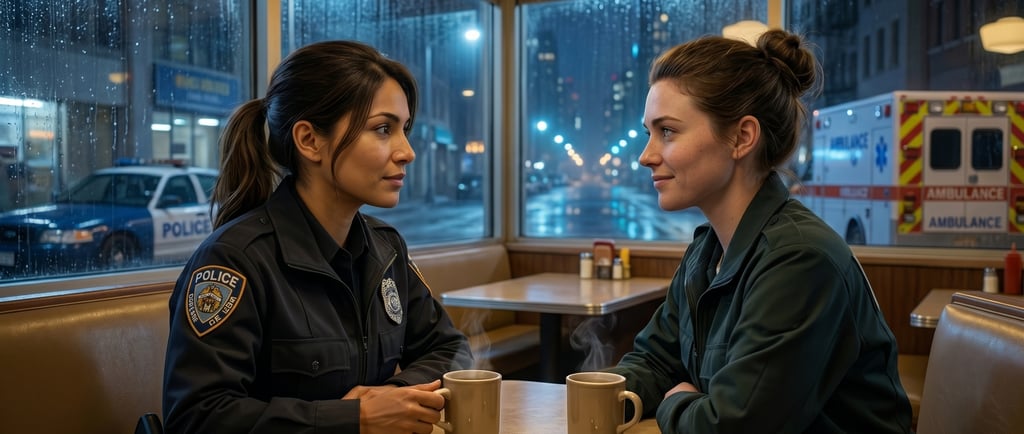
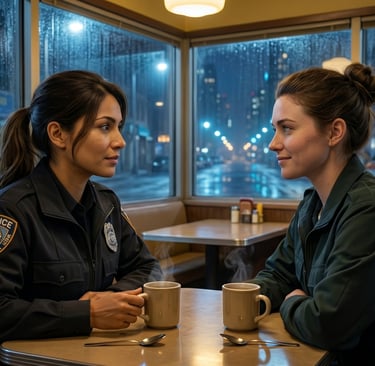
She told herself she stopped at Rose's Diner because she needed coffee.
This was not, strictly speaking, untrue. She did need coffee. Unfortunately, the coffee at Rose's was not good coffee — had never, in all the years Eliza had been going there, aspired to good coffee. But it was hot, available, and tasted faintly of burnt toast and midnight decision-making, and at four in the morning that was sufficient.
Rose's sat on the corner of Larkin and Vale, a relic of an era when diners were built to be found rather than photographed — chrome fixtures gone slightly tarnished, windows that sweated condensation on cold nights, booths upholstered in vinyl the colour of old mustard. The kind of place that had outlasted every trend precisely because it had never tried to be anything other than what it was.
Inside, two taxi drivers occupied a back booth, speaking in the low persistent tones of men who had said everything there was to say to each other years ago and were simply keeping the silence company. A nurse in navy scrubs dozed over a plate of chips, her fork still loosely held in one hand. Rose herself stood behind the counter with a magazine from three months ago and the expression of a woman who had heard every story the night could tell and retained the good ones.
Eliza slid into her usual booth.
"Long night?" Rose asked without looking up.
"Average."
"That means yes."
Eliza didn't argue. Rose brought coffee and toast she hadn't ordered, and Eliza wrapped both hands around the mug and let the warmth work its way into her fingers.
The bell above the door chimed.
She looked up. She would, later, try to account for the particular quality of that moment — the way the bell was still ringing when she registered who it was, the way everything between the bell and the recognition seemed compressed into a fraction of a second that was also, somehow, entirely sufficient.
Jamie Walsh walked in with damp hair and tired eyes and one hand rubbing at the back of her neck, scanning the diner with the distracted look of someone hoping for coffee and not quite expecting company.
Then she saw Eliza.
The distracted look disappeared.
"Eliza," she said, surprised. Pleased. Trying, with limited success, to look merely surprised.
"Eliza now, is it?"
Jamie's mouth curved. "You started it."
"That doesn't mean you were meant to remember."
"I'm a paramedic. We're trained in observation."
"You remembered my name because of professional training?"
"Absolutely."
"That's very convincing."
"Thank you."
Rose appeared with another mug before Jamie had even fully committed to sitting down, set it on the table with the wordless efficiency of a woman who wasted nothing, not motion, not time, not attention.
"Ambulance coffee?" Rose asked.
"Please."
"Condolences."
Jamie slid into the booth opposite Eliza, and the diner, which had felt quite adequately sized a moment ago, seemed to rearrange itself around this development.
* * *
They talked about nothing consequential for a while, which turned out to be exactly the right thing to talk about. Bad coffee. Worse vending machines. The bakery truck that always drove too fast through Kellett Street. Whether the city's possum population was developing some form of coordinated strategy. The conversation moved easily, finding its own level, neither of them steering it toward or away from anything.
Then the quiet came in.
Not awkward. Not empty. Just present, the way quiet was when it arrived between two people who had stopped needing to fill it.
Jamie stirred her coffee without drinking it. "He was scared," she said.
"Arthur?"
"Mm." She watched the spoon move. "He covered it well. But he was on that floor for almost thirty hours not knowing if anyone was coming. That does something to a person."
Eliza looked out at the empty street. The rain had stopped and the footpath gleamed. "His neighbour noticed."
"Because of the newspaper."
"And the lemon tree."
Jamie's gaze lifted.
"People notice the things they love," Eliza said. The words were out before she'd examined them, too honest for four in the morning, too unguarded for a conversation she hadn't known was going to go anywhere.
Jamie didn't tease her. That was, in retrospect, more dangerous than teasing would have been.
She simply looked at Eliza across the table, her face open and unhurried, as if they were somewhere that had all the time in the world.
"Is that why you're good at your job?" she asked.
Eliza nearly laughed. "Because of newspapers and lemon trees?"
"Because you notice what matters to people. The small things they're not asking you to notice."
Eliza looked down at her coffee. Compliments didn't usually unsettle her; she knew what she was good at, knew what she worked for. But Jamie had said it the way someone laid down an observation rather than offered a flattery — matter-of-fact, without performance, as if she had simply looked and seen a thing and reported on it.
"I could say the same about you," Eliza said.
"Me?"
"Arthur was terrified of going to hospital. You made him laugh."
"That's different. That's just talking."
"No," Eliza said. "It isn't."
Jamie looked away. In the corner, the nurse shifted in her sleep; the fork fell from her hand and she didn't wake. Rose turned a page. Outside, a street sweeper passed in a slow mechanical hush.
"So," Jamie said after a moment, the single syllable lighter, recalibrating. "Do you always water strangers' lemon trees?"
"Only on Tuesdays."
"It's Wednesday."
"I'm flexible."
"That's good to know," Jamie said, and something in the way she said it — level, warm, carrying more weight than the words warranted — made Eliza lose track briefly of what she'd been about to do with her hands. She picked up her coffee mug instead.
They stayed longer than either of them meant to. The diner ticked around them — the taxi drivers finishing their shift, the nurse eventually waking with a start and leaving, Rose refilling mugs without commentary. They talked about Jamie's two brothers, both loud, both convinced she was wasting herself by not becoming a doctor, which she described with the fond exasperation of someone who had fought this battle so many times it had become a form of entertainment. They talked about Eliza joining the police at twenty-six, later than most, after three years in an office job she had disliked so thoroughly it had cured her of ambivalence permanently. They talked about Eliza's mother who called every Sunday and asked whether she was eating properly, and about the chihuahua Eliza had nearly arrested during a noise complaint.
"It was vicious," Eliza said.
"It was a chihuahua."
"A tiny criminal."
"You considered arresting a dog?"
"Briefly."
Jamie was laughing properly now, one hand over her mouth, her shoulders moving, and the sound was warm and low and entirely unreasonable given the hour and the context and the fluorescent lighting, and Eliza thought, quite distinctly: this is a problem.
Rose refilled their cups. The clock above the counter ticked to 4:12.
"I should go," Eliza said. The words came out reluctantly enough that she could hear it herself.
Jamie heard it too. Of course she did.
"Me too," she said, making no immediate move.
The radio at Jamie's shoulder cracked to life, dispatching her unit back toward the hospital. The moment closed around the sound and then released them both.
Jamie stood, reaching into her pocket. "I've got it," Eliza said, before she could put money on the table.
"You don't have to."
"I know."
A beat. Jamie looked at her — a look that lasted perhaps two seconds longer than the exchange warranted.
"Thanks," she said.
"Professional courtesy."
"Right." The smile was smaller this time, turned slightly inward. "Goodnight, Eliza."
"It's morning."
"Not until I've slept."
"Fair."
Jamie turned toward the door. At the threshold she glanced back — one quick, unguarded look, the kind people gave when they thought they'd already been dismissed — and then lifted two fingers in a small wave and stepped out into the blue edge of dawn.
The bell above the door chimed behind her.
Eliza sat alone in the booth, listening to the city begin to remember itself. Rose came by with the coffee pot.
"You want more?"
"No. Thanks."
Rose looked toward the door, then back at Eliza, with the mild expression of a woman who had seen this precise scene more variations of than she could count.
"Nice girl," Rose said.
"She's a paramedic."
"I didn't ask for her occupation."
Eliza stood too quickly. "I need to get back."
"Course you do."
There was a smile in Rose's voice that Eliza chose, very deliberately, not to acknowledge.
Outside, the morning had thinned the clouds to something silver and tentative. Ambulance 42 was gone from the kerb. The patrol car waited under a streetlamp that hadn't yet realised it was no longer needed.
Eliza got in. Fastened her seatbelt. Started the engine. Checked the mirrors. A normal sequence of ordinary actions.
Then she caught herself scanning the road ahead, looking for blue stripes and one brake light brighter than the other.
She stopped.
Her hands rested on the wheel.
The city did not sleep. It softened. And somewhere in the softest hour of the morning, without sirens or warning, something in Eliza had shifted — small and cellular, the way the earliest changes always were, below the threshold of naming.
Nothing important, she told herself.
Just coffee. Just conversation. Just Jamie Walsh saying her name like it belonged somewhere warmer than a police radio.
The call came through before she could think too hard about that.
She answered it. She drove. And at every intersection after that, she looked for Ambulance 42.
Listen to the abridged narrated version here:

Contact
Questions or thoughts? Reach out anytime.
© 2025. All rights reserved.