The Question I Carried
SHORT STORY
12/10/20254 min read
The Question I Carried
I never meant to fall for her. It just sort of… happened, the way sunlight fills a room even when the curtains are only slightly parted. One minute I was filing reports at my tiny corner desk, and the next she walked through the office door with her sleeves rolled up, hair pinned back, and the kind of calm confidence that made everyone pause.
Her name was Elise.
I pretended not to stare every time she said it during meetings. I also pretended I was completely fine around her, which was a bald-faced lie. She was thirty, maybe thirty-one, with this warm, steady presence that made people straighten their posture without realising they were doing it. I was twenty-five and chronically awkward around anyone I found attractive. Which meant: profoundly awkward around her.
We didn’t work closely, but we crossed paths often enough that I built an entire collection of tiny interactions in my head. A nod in the hallway. A shared laugh over a glitchy printer. The time she held the door for me and I said “thanks” too quietly, then spent the rest of the day wondering if she thought I’d whispered something unintelligible on purpose.
She was out of my league. That was the story I told myself, over and over, polished smooth with repetition. Elise dated polished people. Decisive people. People who didn’t still break into a sweat ordering coffee.
And then, one Thursday afternoon, everything shifted.
I was restocking notebooks in the supply cupboard when she appeared behind me, leaning against the doorframe as if she had all the time in the world.
“You always manage the impossible,” she said.
I froze mid-stack. “The impossible?”
“These cupboards. Every time I open them they look like the aftermath of a small office tornado. And then you come in, and somehow everything is perfect again.”
It wasn’t flirting. I told myself this sternly. Compliments were not flirting. Elise was nice to everyone.
Still, her eyes lingered a little longer than usual.
“You’re very organised,” she added, almost thoughtfully.
“I… try,” I said, which was tragically un-charming.
She smiled. I felt the smile physically, like a soft press behind my ribs.
After she left, I slammed the cupboard door shut, leaned against it, and whispered, “I need to stop being in love with her.”
But of course I didn’t. I couldn’t. The more I tried to file the feeling away, the more it curled around me.
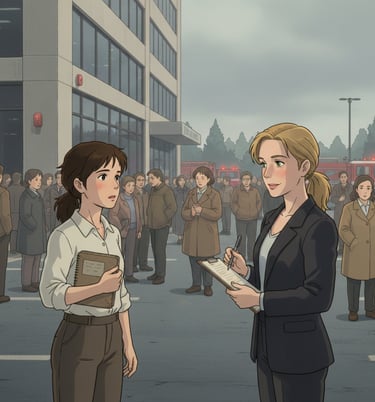
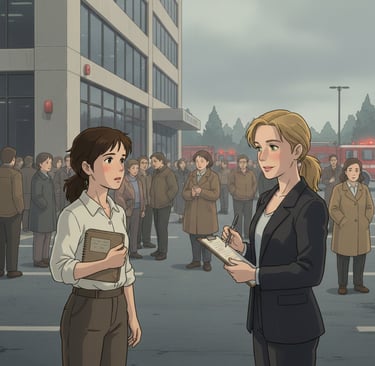
The turning point came a week later, during our building’s fire drill. Everyone spilled into the parking lot in that half-annoyed, half-liberated way people do when their afternoon is interrupted. Elise stood off to the side, sleeves rolled up again, holding a takeaway cup that fogged in the cool air.
I stood three metres away and rehearsed what I absolutely would not say to her.
You’re beautiful.
I like you too much.
Please be polite about rejecting me.
She caught me looking. I looked away so fast I nearly strained something.
And then I thought, wildly: I’m tired of wishing. I’m tired of waiting for the courage to stop being shy.
I walked toward her. Each step felt like tossing a pebble at fate’s window.
“Hey,” she said when I reached her. Her smile was soft, curious. “Survived the great annual alarm test, I see.”
“Barely,” I managed. My voice felt like it belonged to someone braver. Someone I wanted to be.
Her head tilted. “You okay?”
“Yes. No. Kind of.” I exhaled. “I’m nervous.”
She straightened, concern flickering across her face. “About what?”
“You.”
A beat. The wind nudged a strand of hair across my cheek. I tucked it behind my ear with a hand that wasn’t quite steady.
“I like you,” I said. “More than casually. More than someone I pass in the hall. And I know there’s an age difference, and I know you probably don’t think of me that way, but I needed to say it. Before I talked myself out of it for the rest of my life.”
Her eyes widened—surprised, not alarmed. Something softer bloomed there, like recognition taking shape.
“You think I don’t see you?” she asked quietly.
“I— well, yes?”
She stepped closer. Just enough that the world felt a little warmer.
“I’ve noticed you from the first week you started,” she said. “Noticed how kind you are. How thoughtful. How you fix the cupboard like you’re patching up the whole building, piece by piece. I didn’t want to assume you’d ever see me as anything more than the woman who keeps breaking the printer.”
I laughed, startled. “You don’t break it. It self-destructs when you walk past.”
Her smile curved, a slow unfurling.
“I’m glad you said something,” she murmured. “Because I wanted to. I was just afraid you’d think I was being inappropriate.”
The world tilted in the gentlest way.
“So,” she added, hands sliding into her pockets, “would you like to get a coffee with me sometime? Outside of work. Somewhere quiet.”
I blinked. “Are you asking me out?”
“Yes,” she said. “Unless you’d prefer to be the one asking.”
My voice stumbled over its own excitement. “Can I? Ask, I mean?”
“Please do,” she said, eyes bright with something that turned my heartbeat buoyant.
“Okay,” I breathed. “Elise… would you like to go out with me?”
“I would love to.”
It struck me then how light I felt. How all this time the question hadn’t been a weight, but a seed waiting for daylight.
The fire drill ended. People shuffled back inside. Elise and I walked slower than everyone else, our steps brushing close, the promise of something new pacing quietly between us.
I didn’t stop smiling for the rest of the day. And when she texted me that evening—I’m glad you asked—the smile only grew, taking root, unfurling warmth through every hour that followed.
Something had finally begun. And it was brighter than anything I’d dared imagine.
Contact
Questions or thoughts? Reach out anytime.
© 2025. All rights reserved.