The Song That Knew Her Name
A Bittersweet Sapphic Sleep Tale
SHORT STORYROMANCEDRAMA
12/31/202515 min read
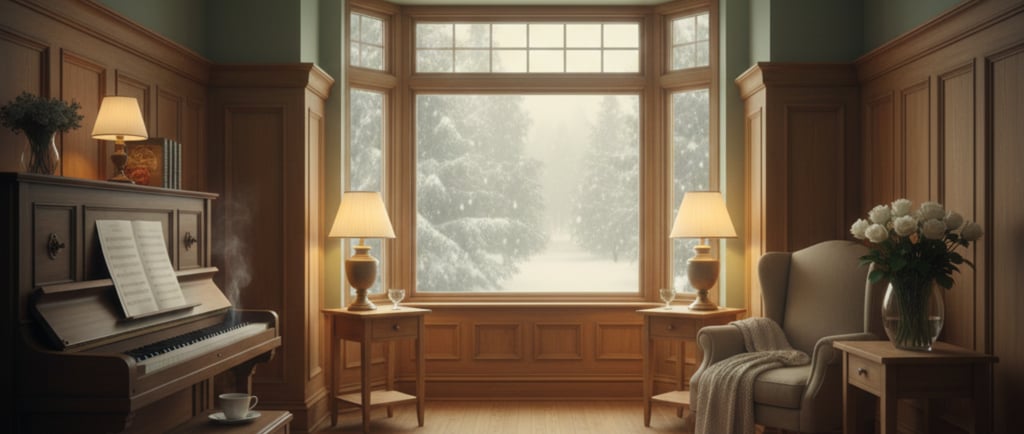
The Song That Knew Her Name
Before I ever played the song for her, I already knew it was hers.
I just didn’t know what it would cost me to admit that.
I used to think songs were born from the big moments. From disasters. From sweeping romance. From the kind of heartbreak that made you dramatic, the kind people romanticised because it looked poetic from a safe distance.
Turns out, the songs that change you come from smaller things.
A hallway window.
A half-remembered hum.
A woman in a moss-coloured beanie tapping time against her thumb like she had a secret metronome stitched into her pulse.
The first time I saw June, I wasn’t looking for her.
I was at the hospice because my aunt had asked me to visit her friend, and because guilt is a reliable driver when you don’t know what else to use. I told myself I was doing a good thing, told myself it was a simple errand of compassion, the emotional equivalent of returning a borrowed book.
I signed in at the front desk and wore the visitor badge like an apology.
The building was warm in that careful way, like someone had made the decision to keep it from feeling too much like a place people came to die. Lamps instead of fluorescents. A bowl of mints. A shelf of board games no one wanted to admit they still liked.
I was halfway down the corridor when I heard the humming.
It wasn’t loud. It wasn’t even perfectly in tune. It was a thread of sound tugging at the air, stubborn enough to be noticed.
I followed it the way you follow a scent that reminds you of something you can’t place.
June was at the end of the hall by the window, seated in a wheelchair with a knitted blanket folded over her legs. Outside, the trees were bare and thin, like sketches of trees instead of trees. The sky looked like it was trying to decide whether it wanted to snow or simply keep being bleak.
June’s beanie matched the moss on the trunks outside. Her cheeks were pale, but her eyes were alive. Not bright in a cheerful way. Bright in a watchful way. Like she’d been paying attention longer than most people knew how to do.
She stopped humming when she noticed me.
“Sorry,” she said immediately, like sound itself was a crime here.
“Don’t apologise,” I blurted. “It was… nice.”
June’s mouth twitched. “Nice. That’s what you say when you’re trying not to say something else.”
I couldn’t help it. I laughed, a quick burst that felt too sharp in the quiet. I covered my mouth.
June smiled. Really smiled. And something in my chest loosened, like a knot I didn’t know I’d been carrying.
“You’re lost,” she said, her gaze flicking to my visitor badge.
“Is it that obvious?”
“You have that look.” June nodded toward the corridor behind me. “Like you’re trying to find the right door and also the right emotional temperature.”
That was… exactly it, which was unsettling.
“I’m visiting someone,” I said. “My aunt’s friend.”
June nodded as if this fit neatly into her internal filing system. “Good for you. People avoid this place. It scares them. Makes them too aware of their own… temporary status.”
She said it with an easy bluntness, like she’d already had the worst conversations and had no interest in sugarcoating the rest.
I shifted my weight, uncertain. “I should go.”
“You should,” June agreed. Then, after a beat, “But you’ll come back.”
I stared. “Excuse me?”
June’s eyes crinkled slightly. “You have the face of someone who collects unfinished moments.”
I opened my mouth, closed it again, then admitted, “I don’t know what that means.”
“Neither do I,” June said cheerfully. “It just sounded right.”
I should have walked away.
I did walk away, technically. I found my aunt’s friend, sat by her bed, held her thin hand and made gentle conversation that felt like trying to cup water without spilling it. I stayed the appropriate amount of time. I said, “It was lovely to see you,” and meant it, and also meant, I’m sorry the world is like this.
Then I left her room, and my feet took me right back down the corridor.
June was still by the window.
She glanced up as I approached, as if I was a late bus she’d already predicted. “See?” she said. “Told you.”
“I’m not back,” I lied. “I’m just… passing.”
June patted the space beside the window, where there was no chair, just a slice of sunlight on the floor. “Sit. Keep me company. Tell me something that isn’t about illness.”
I hesitated. Visitors weren’t supposed to… what? Make friends?
But June looked at me like we were both just people, and the rules of this building were secondary.
So I sat on the windowsill.
“I work at a bookstore,” I said, because that was the first harmless thing I could offer.
June’s face lit with interest. “Oh, dangerous. Books are gateways.”
“Gateways to what?”
“To anything.” June’s fingers tapped time against her thumb again. “Tell me what kind.”
I told her, and she asked questions. The kind of questions people ask when they actually want to know, not the kind they ask to fill silence.
Somewhere in the middle of describing the shop’s tiny poetry section, I mentioned my piano. Mentioned that I wrote music sometimes. As if it was a casual fact, like I had a favourite colour.
June’s gaze sharpened. “You write music.”
“I dabble,” I said quickly.
June hummed again, thoughtful. “That explains it.”
“Explains what?”
“Why you look like you’re always listening to something that isn’t there.”
My throat tightened, because no one had ever said that to me, and it was too accurate.
June tilted her head. “What’s your name again?”
I told her.
She repeated it softly. Like she was learning the shape of it.
The next day, I went back.
I told myself it was because my aunt might ask and I wanted to be able to say I’d visited again. I told myself it was the kind thing to do, to check on my aunt’s friend.
But my feet went to June’s window first.
June was there, blanket tucked neatly, beanie on, her fingers tapping quiet time.
“You’re becoming predictable,” she said.
“I am not.”
“You are.” June’s smile was satisfied. “Sit.”
So it became a ritual.
June and the window. Me and my awkward visitor badge. The corridor’s hush making everything feel more intense, like life turned down the volume so you could hear the important things.
Some days June was energetic, animated, telling stories that made the nurses pause in the doorway to listen. She talked about the wild things she’d done in her twenties: hitchhiking to see the ocean, learning to bake bread from an old neighbour who hated everyone but loved teaching, kissing a girl behind a concert hall and then pretending it hadn’t happened because the world didn’t feel safe for honesty.
Other days she was tired, eyes heavy, breath shallow.
On those days I read to her from whatever book I’d brought, and she listened with her eyes closed, sometimes smiling at a line like it had landed in the right place.
Over time, I learned the little truths that made up June.
She hated lukewarm tea. She loved thunderstorms, even when they scared her. She believed birds were tiny messengers from some ancient logic we’d forgotten how to speak. She was gentle in a way that didn’t ask permission.
And she was dying.
Not in the vague abstract sense. Not in the way we all are, technically.
In the real sense. In the way the nurses’ faces shifted when they thought no one was watching. In the way June’s hands grew thinner, the skin more translucent, like paper held up to light.
I didn’t ask what she had. Not at first. It felt rude. It felt like asking someone to name the monster in the room.
One afternoon, June was quieter than usual. She watched the trees outside the window and didn’t make jokes about my messy hair or the way I always brought too many snacks like the corridor was a movie theatre.
“You’re thinking loud,” I said gently.
June blinked and looked at me. “Am I?”
“Yes.”
“That’s unfortunate,” she murmured. “I was hoping it wouldn’t show.”
I waited.
June’s gaze dipped to my hands. “You know what’s strange?”
“What?”
“I didn’t expect this part to feel so… unfinished.” She exhaled softly. “I thought I’d either be terrified or serene. But mostly I just feel annoyed.”
I let out a quiet breath. “Annoyed?”
June’s lips curved. “Because there are still things I want to do. Not big things. Small things. Like walking to a bakery on a cold morning. Like dancing in my kitchen. Like falling in love on purpose.”
My heart stuttered.
June looked back out the window. “But I ran out of time for the last one.”
The words sat between us, heavy and tender.
I could have pretended I didn’t understand. I could have offered a platitude, something about how love comes in many forms.
Instead, I said quietly, “You haven’t run out of time for that.”
June turned her head slowly. Her eyes met mine like a hand finding another hand in the dark. “Is that true,” she asked, “or are you being kind?”
The honest answer was both.
June studied me for a long moment. Then she said, almost to herself, “You’re dangerous.”
I swallowed. “Me?”
“You,” June confirmed. “Because you look at me like I’m still here.”
“I am,” I whispered.
June’s throat bobbed, like she was swallowing something. “Yes,” she said softly. “You are.”
That night, I couldn’t sleep.
I lay in bed with my hands on my stomach, staring at the ceiling, listening to the city’s distant sounds and the occasional rush of a car on wet roads. I thought about June’s laugh. About her blunt honesty. About the way she’d said falling in love on purpose like it was something she’d missed and also something she still wanted.
And then, like a thief, the melody arrived.
It didn’t ask if I was ready. It didn’t care about my fear.
It started with a simple line, soft and steady, and then it rose, like someone gathering courage.
I got out of bed, moved to my piano in the corner of my tiny apartment, and placed my fingers on the keys as if they were a pulse.
The song came out like confession.
It wasn’t dramatic. It wasn’t tragic. It didn’t sound like illness or endings.
It sounded like June at the window.
It sounded like attention.
It sounded like the strange, bright ache of being seen by someone who was running out of time, and seeing them back.
When it was finished, I sat with my hands in my lap, breathing like I’d run a long distance.
I recorded it on my phone, not because it deserved that kind of small recording, but because I needed proof it existed. Proof I hadn’t imagined it.
And then I did what I always do when I’m afraid.
I delayed.
I visited June, but I didn’t play the song.
I brought her tea, hot enough to satisfy her standards, and she rolled her eyes like I’d done something basic and therefore suspicious.
“You’re hovering,” she said one afternoon.
“I’m not.”
“You are.” June’s smile was gentle. “What are you hiding?”
I opened my mouth, then closed it.
June watched me patiently, like she had all the time in the world, which was both funny and devastating.
“I wrote something,” I admitted finally.
June’s eyes brightened. “A song.”
“Yes.”
June’s expression softened. “For who?”
I could have lied.
I could have said I didn’t know yet.
But the truth was already in my bones, and lying would have cost more than honesty.
“For you,” I said.
The silence that followed was so quiet it felt like the building itself had leaned in.
June’s eyes filled with something that wasn’t pity. Something sharper. Something like wonder mixed with grief.
“Well,” she said softly. “That’s a bold choice.”
I gave a helpless laugh. “It wasn’t a choice. It just… arrived.”
June nodded as if she understood that completely. “Music is rude like that.”
I pulled out my phone, thumb hovering over the play button.
June lifted a hand. “Wait.”
I froze.
June reached for my fingers, threading hers loosely through mine. Her skin was cool, but her grip was steady.
“Before you play it,” she said, voice quiet, “I need you to know something.”
My heart hammered so hard it felt like it might bruise.
“I’ve had visitors who love me,” June said. “Family. Friends. People from old jobs. People who show up with casseroles and careful voices.” She swallowed. “And I’m grateful. I am.”
I didn’t speak.
“But they look at me like I’m already… a memory,” June continued. “They try to make it neat. Like they can wrap me up in soft words and put me away where it won’t hurt.”
My throat tightened.
“You don’t do that,” June said, eyes shining. “You sit with me like I’m still a person with a future, even if it’s short.”
“I can’t stop seeing you,” I whispered, and the words came out raw.
June’s thumb brushed my knuckle. “Good,” she murmured. “Then play it. Not like it’s a goodbye.”
I hit play.
The piano filled the room, soft and steady. The melody moved like tidewater, gentle but certain. It rose into brightness, then folded back into something tender. It sounded like a door opening, not slamming shut.
I watched June while she listened.
At first her gaze was fixed somewhere past me, like she was staring into a place the song had unlocked. Then her eyelids lowered. Her shoulders relaxed, the tension easing out of her as if the music had been holding it for her without either of us realising.
When the final note faded, the quiet afterward felt enormous.
June opened her eyes slowly.
Before she could speak, I heard myself say, “Before I ever played it for you, I already knew it was yours.”
June’s smile trembled. “I know,” she whispered. “I can hear it.”
Tears pricked my eyes. “I just didn’t know what it would cost me.”
June’s gaze softened, warm and fierce at once. “What did it cost you?”
“The pretending,” I said.
June nodded once, satisfied. “Pretending is expensive.”
I didn’t plan what happened next.
I leaned forward and kissed her knuckles, gentle as prayer. It wasn’t a movie moment. It was a small truth placed carefully on her skin.
June’s fingers curled slightly, holding me there for a second longer than necessary.
“Come closer,” she murmured.
I stood, careful of wires and tubes, and leaned over her bed. June lifted her other hand and cupped my cheek, thumb brushing once, as if memorising.
Then she kissed me.
Slow. Soft. Certain.
A kiss that didn’t ask for permission from time.
When she pulled back, she rested her forehead against mine.
“I’m dying,” she said quietly, like she was naming the weather.
“I know.”
June’s breath was warm against my lips. “And still,” she said, “I want this. If you do.”
“I do,” I whispered. “I do.”
June smiled, small and bright. “Then we do it properly.”
So we did.
Not with grand gestures. Not with a dramatic escape from the hospice and a montage of bucket-list adventures. We did it with what we had: hours, tenderness, attention.
I brought her tea and books and the cinnamon buns she’d been craving, and she made a face like they were mediocre even while eating them like they were holy.
I read to her when her eyes were too tired to focus. I told her about my day, even when it was boring, because June insisted boredom was underrated.
“I’m sick of dramatic,” she said. “Tell me about the customer who tried to return a book because it was ‘too emotional.’”
She laughed, and sometimes the laughter turned into a cough, and I learned how to pause, how to wait, how to hold her hand until she could breathe again.
Some evenings, when she had energy, I played the song again on my phone, or I hummed it softly when she asked. Once, I brought my small keyboard into her room, feeling ridiculous and determined at once.
June watched me set it up, amused. “Bold,” she said.
“I’m trying to do it properly,” I replied.
June’s gaze softened. “Then play,” she murmured.
I played quietly, so as not to disturb the corridor’s hush. June closed her eyes and listened, her hand resting on the blanket, her fingers tapping time against her thumb. When I finished, she opened her eyes and said, “It sounds like me.”
“It is you,” I said.
June smiled, and for a moment she looked entirely unafraid.
Time, of course, kept doing what it does.
June began to sleep more. Her voice grew softer. Some days she didn’t want to talk, just wanted me there, my hand on her arm, my presence a steady note.
One night, the sky outside her window was black and full of rain, and June asked me to climb into the bed beside her, carefully, fully clothed, just close enough that our shoulders touched.
“I’m cold,” she said simply.
I curled beside her, and her body felt light, fragile in a way that made my throat ache.
June’s hand found mine under the blanket.
“You’re crying,” she murmured after a moment.
“I’m not,” I lied.
June hummed softly. The half-remembered tune from her mother, the one without words.
I listened, and then, without thinking, I hummed my melody under hers. Not overriding it, just weaving beneath it, like a second voice.
June’s humming faltered, then found my harmony.
When we finished, June exhaled. “There,” she whispered. “That’s the feeling.”
My eyes burned. “What feeling?”
“Being held,” June said.
I turned my face toward her, careful not to jostle tubes, and kissed her temple. Her skin smelled faintly of lavender lotion and hospital soap. Human and real.
June’s voice was small. “Promise me something.”
“Anything,” I whispered.
“When I’m gone,” she said, “don’t turn this into a tragedy. Don’t let people use me as a lesson.” Her fingers tightened around mine. “Just… let it be what it was.”
My throat tightened. “What was it?”
June’s eyes shone. “A love story,” she said simply. “A short one. But real.”
Tears slipped down my cheeks. I didn’t wipe them away.
June’s thumb brushed my knuckle, slow and gentle. “And play the song,” she added. “Even if it hurts.”
“It will hurt,” I admitted.
June smiled faintly. “Yes. But it will also remind you that I existed. That I was loved.” She swallowed. “We all deserve that. Even if we don’t get a long time.”
I pressed my forehead to hers, breathing in her warmth, holding the moment like it was the last candle in a dark room.
“I’ll play it,” I promised.
June’s eyes closed. “Good,” she whispered. “Because it’s mine.”
She fell asleep with her hand in mine, and I stayed until the nurses gently told me visiting hours were over.
In the corridor, the lights buzzed softly, and the air felt too large around me.
I walked to my car under a sky heavy with rain, my chest full of love and dread. I sat in the driver’s seat and didn’t start the engine for a long time.
Because here was the truth I hadn’t wanted to name.
I had written a song for a woman who would not live long enough to hear it a hundred times. I had fallen in love in a place designed to hold endings. I had let myself believe in something beautiful even while the clock was ticking.
And still, I didn’t regret it.
Because June had looked at me like I mattered. Like I was real. Like I was worth choosing.
And for however many days remained, I would choose her back.
After June died, the world didn’t stop. It never does, which is both cruel and strangely merciful. People still bought groceries. Cars still honked. The bookstore still smelled like paper and coffee, and customers still complained about things that suddenly seemed hilariously unimportant.
I moved through it like someone carrying a secret.
At night, I sat at my piano and played her song softly, letting it fill my apartment the way her presence had filled that corridor window.
It hurt, yes.
But it also made her feel close.
Weeks later, I was asked to play at a small memorial gathering the hospice held sometimes for families and friends. I almost said no. The thought of letting my grief become public felt unbearable.
But then I remembered June’s voice: Don’t lock it away. Don’t make it neat. Let it be what it was.
So I said yes.
The hospice lounge was warm, lamps lit, people sitting close together. June’s beanie was folded neatly on a table beside a framed photo of her laughing, mid-sentence, as if she’d been caught being alive.
I sat at the piano they kept there for volunteers, my hands trembling.
Before I played, I looked up at the window at the end of the corridor, the one where June and I had watched the bare trees.
I could almost see her there, blanket over her knees, fingers tapping time against her thumb.
I took a breath, and I played.
The melody rose and softened, bright and tender. It didn’t sound like a goodbye. It sounded like attention. Like courage. Like love that had happened anyway.
When I finished, the room was quiet.
Then someone began to cry, softly. Not the dramatic kind. The honest kind.
A nurse approached me afterward, her eyes wet. “That was beautiful,” she whispered. “Was it… hers?”
I swallowed hard. “Yes,” I said. “It was always hers.”
That night, I went home and sat at my piano in the dark, listening to the quiet after the notes were gone.
I thought about the cost. The pretending I’d paid with for years. The fear. The hesitation. The way I’d almost missed her because I’d been too careful with my own heart.
June hadn’t given me a forever.
But she had given me a truth.
That love doesn’t owe you a perfect ending to be worth everything.
That we all deserve to love and be loved.
Even when timing is cruel.
Even when the story is short.
And every time I play the song now, I feel it again.
Not just the grief.
The gift.
Before I ever played it for her, I already knew it was hers.
I just didn’t know how much it would change me to finally say it out loud.
Contact
Questions or thoughts? Reach out anytime.
© 2025. All rights reserved.